

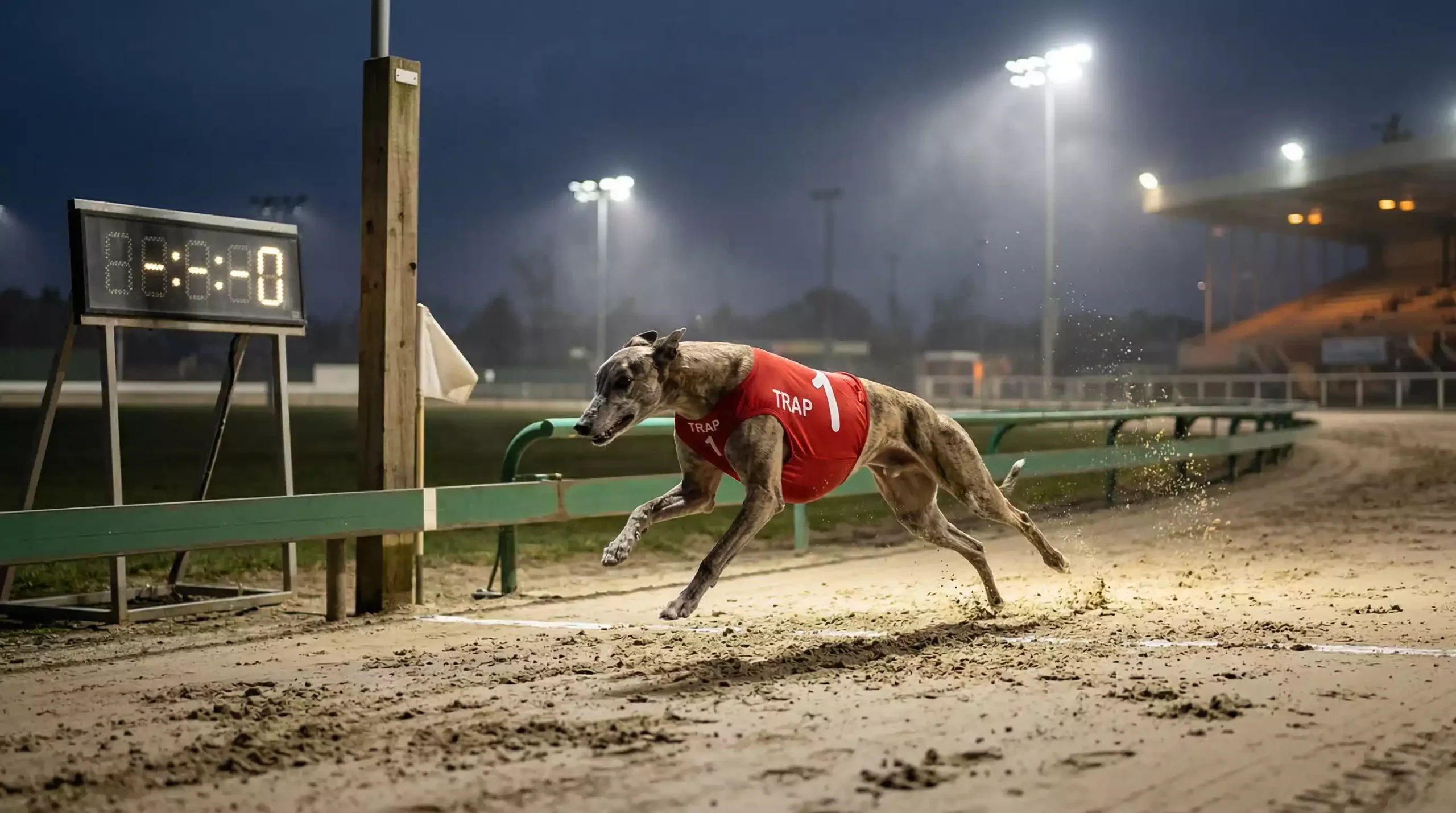
The Official Records That Define Nottingham’s Identity
Every greyhound track has a personality, and track records are the clearest expression of it. At Nottingham, the records across eight racing distances tell a story about the oval’s geometry, its surface, the calibre of dogs that have competed there and the four-and-a-half decades of racing that have unfolded since the stadium opened its traps for the first time.
That first time was 24 January 1980, when Colwick Park staged its inaugural meeting in front of more than 2,000 spectators. The first race winner was a greyhound named Tartan Al, trained by W Horton, who crossed the line in 32.98 seconds over 500 metres at odds of 7/1. That time looks pedestrian by modern standards — the current 500-metre record is substantially faster — but Tartan Al holds a distinction that no other greyhound can claim at this venue. Every record that followed was a refinement of the benchmark that dog established on opening night.
Nottingham greyhound track records matter beyond their historical curiosity. They are the yardstick against which every contemporary performance is measured. When a dog clocks a time within half a second of the track record on a standard graded evening, it signals a level of ability that exceeds the competition it just beat. When a punter sees a recent time listed on the racecard and knows how it compares to the all-time benchmark, the number gains meaning. This guide catalogues every Nottingham record by distance, explains the context behind each one and traces the progression from Tartan Al to the present day.
305m Sprint Records: The Fastest Dogs Over Two Bends
The 305-metre sprint at Nottingham is a two-bend race that rewards one quality above all others: acceleration out of the traps. The distance is short enough that the race is frequently decided before the field reaches the back straight. A dog that breaks a tenth of a second faster than its rivals and hits the first bend — approximately 85 metres from the traps on the standard course geometry — in front will often hold that lead to the line.
The track record over 305 metres stands to Romeo Steel, who clocked 17.32 seconds. To appreciate that time, consider what it requires. The dog covered 305 metres in fewer than 18 seconds, which translates to an average speed of roughly 63 kilometres per hour. The peak speed through the finishing straight would have been considerably higher than the average, with the two bends — where the dog decelerates into the turn and re-accelerates out of it — bringing the overall number down. It is a time that demands an almost perfect combination of trap speed, cornering efficiency and raw pace on the straight.
Sprint records are the most fragile records on any track’s books, in the sense that they depend heavily on a single burst of speed rather than sustained effort. A supremely fast dog at the peak of its form, drawn in a favourable trap on a fast-going night, can produce a time that stands for years — not because the dog was uniquely talented across all distances, but because the conditions aligned perfectly for 17 seconds. The counter-intuitive consequence is that sprint records are often set by dogs that are not the track’s most celebrated competitors. The greyhounds remembered in Nottingham’s history tend to be the 500-metre and stayer champions who won major events, while the sprint record holder achieved something quieter but, in its own way, more remarkable.
For punters, the 305-metre record provides a benchmark for evaluating sprint form. A dog that consistently runs within a second of the track record — 18.30 or faster — is operating at an elite level for this distance. A dog that runs 18.50 to 19.00 is competitive but not exceptional. And a dog that runs 19.00-plus on a standard going night is likely to find the pace too hot against the sharper sprinters in the field. The racecard will show the best time; the record gives that time its meaning.
The trap draw influence on sprint records deserves mention. It is no coincidence that many sprint record times across UK tracks are set from the inside traps. Trap 1 gives the shortest route to the first bend, and over a two-bend distance, saving even half a metre on each turn represents a measurable time advantage. When assessing whether a sprint time is genuinely exceptional or was assisted by a favourable draw, check the trap from which it was recorded — the information appears in the full race archive and gives context that the time alone does not.
480m and 500m Records: The Heartbeat Distances
The 500-metre distance is Nottingham’s signature trip. It is the distance that fills the majority of graded cards, the distance on which the grading system is most rigorously applied, and the distance where the depth of competition is greatest. The 480-metre variant exists as a slightly shorter alternative, but the 500 is the standard — the distance that defines what fast means at this track.
The 500-metre track record belongs to Proper Heiress, who stopped the clock at 28.95 seconds. Breaking 29 seconds on a 437-metre circumference is a significant achievement. The dog negotiated four bends and two full straights at an average speed that left no margin for hesitation, crowding or a suboptimal racing line. The record time implies that virtually everything went right: a fast break from the traps, clean running through the bends, no interference from the field and a surface playing fast on the night.
The first winner over 500 metres at Nottingham — Tartan Al, in 32.98 seconds on opening night in 1980 — provides a striking contrast. The gap between 32.98 and 28.95 represents four seconds, or roughly 25 metres at race pace. That improvement over four-plus decades reflects advances across every dimension of the sport: genetics, nutrition, training methods, track surface technology and hare system engineering. The greyhound running 28.95 today is a fundamentally different athletic specimen from the one running 32.98 in 1980, even though the track layout is the same.
The 480-metre records stand slightly slower in raw terms — the shorter distance means fewer metres of finishing straight, which is where dogs typically achieve their peak speed. But the 480 carries its own competitive identity at Nottingham. Some meetings card the shorter trip instead of the standard 500, and dogs that thrive over 480 are not always the same dogs that thrive over 500. The extra 20 metres can be the difference between a frontrunner holding on and a closer catching it on the line. When you see a dog’s best time listed on the racecard, check whether it was recorded over 480 or 500 — the distinction matters for accurate form comparison.
For analytical punters, the 500-metre record is the single most useful benchmark in the Nottingham record book. Almost every graded race on a Monday or Friday evening is run over this trip. Knowing that the record is 28.95 means you can immediately contextualise any time on the card: a dog running 29.50 is within 0.55 seconds of the all-time best, which puts it in the top tier of current performers. A dog running 30.50 is a full 1.55 seconds off the record, which might still be competitive in an A6 or A7 race but would be outpaced in an A1 event. The record anchors the scale.
680m and 700m Records: Where Stamina Starts to Count
The transition from standard to middle-distance racing at Nottingham happens at 680 metres. At this trip, the race extends beyond four bends into five or six, and the physiological demands shift. Early speed still matters — the first bend arrives at the same point regardless of distance — but it is no longer sufficient on its own. Dogs that set blistering early fractions and fade on the back straight are punished at 680 metres and above. The middle distances reward dogs that can sustain pace, manage their energy through multiple turns and still produce a strong finish.
The 680-metre record at Nottingham reflects this dual demand. The holder is a dog that combined tactical speed with genuine staying power, recording a time that demonstrates efficient cornering — minimising the deceleration-reacceleration cycle at each bend — and a finishing section that held up under fatigue. Middle-distance records are harder to break than sprint records for a simple reason: the longer the race, the more variables must align. Over 305 metres, a perfect trap break on a fast night can produce a record. Over 680, the dog must sustain that level through five bends and across a racing distance that stretches beyond one full lap of the 437-metre oval.
The 700-metre distance adds a further bend and approximately 20 more metres to the journey. The difference between 680 and 700 is subtle in terms of raw distance but meaningful in terms of race dynamics. The additional ground typically includes an extra half-bend and a longer finishing straight, which gives closers an additional opportunity to reel in tiring frontrunners. Trainers who specialise in middle-distance runners often have strong opinions about which trip suits each individual dog, and a form string that shows strong 680 performances does not automatically translate to 700-metre competence.
For the analytical punter, middle-distance races at Nottingham are where trainer expertise becomes most visible. Preparing a dog to peak over 680 or 700 metres requires specific conditioning: longer exercise runs, controlled trial work over the precise distance, and nutritional management that supports endurance. Trainers with a track record of producing middle-distance winners at Nottingham have solved these preparation challenges, and their entries at this trip carry more weight than a dog from a kennel that primarily campaigns sprinters.
885m, 905m and 925m: Nottingham’s Marathon Distances
Nottingham’s longest distances — 885, 905 and 925 metres — take dogs through six or more bends and represent the ultimate test of stamina on this track. These are the marathon distances where the sprint-bred dogs fall away and only the genuine stayers survive. The races last upwards of 55 seconds, which does not sound long by human athletic standards but represents a maximal effort for a greyhound covering that ground at sustained speed.
The marathon records at Nottingham carry a particular distinction. They are set by dogs that combine two qualities that rarely coexist at the highest level: speed and endurance. A dog fast enough to compete over 500 metres but with the stamina to sustain that speed for nearly twice the distance is a rare animal. The breeding that produces marathon greyhounds draws from specific sire and dam lines known for their staying characteristics — larger frame dogs with efficient cardiovascular systems and the temperament to settle into a rhythm through the middle stages of a race rather than burning out at the front.
David Evans, General Manager of Nottingham Stadium, captured the venue’s broad competitive identity when describing a recent run of success, calling it “another bumper year at Nottingham Stadium with four new Category One champions crowned.” That diversity of championship racing across multiple distances is what distinguishes Nottingham from tracks that specialise in one format. The marathon events contribute to the track’s status as one of the most complete racing venues in the country, attracting stayer specialists from kennels that might not otherwise travel to the East Midlands.
For punters, marathon races at Nottingham demand a specific analytical approach. Recent form over similar distances is the primary indicator — a dog winning A3 races over 500 metres tells you almost nothing about its prospects over 905 metres. Trap draw becomes less decisive at these distances, as the sheer number of bends provides multiple opportunities for the field to reshuffle, and the energy cost of running wide accumulates to a point where the wider-drawn dog must have significantly superior stamina to compensate. Finishing speed — how the dog closes over the final two bends — is the most predictive metric. Marathon dogs that accelerate in the final quarter are the ones that win these races, and the comment lines in the racecard (RnUp, strong finish notations) tell you which dogs fit that profile.
How Nottingham Records Have Fallen: A Timeline Since 1980
The arc of Nottingham’s record progression mirrors the evolution of British greyhound racing itself. In 1980, when Tartan Al won the first race at Colwick Park in 32.98 seconds, the sport was still operating with older surface technology, less sophisticated training methods and breeding programmes that had not yet achieved the genetic refinement visible in modern greyhounds. The records set in the early years reflected these limitations — honest times for their era, but times that would not be competitive in the lowest grades today.
Through the 1980s and 1990s, records fell steadily as the sport professionalised. Track surface management improved, with sand composition and drainage systems becoming more scientific. Training regimes incorporated veterinary sports science, and nutrition for racing greyhounds moved from general-purpose feeding to performance-specific diets. Each improvement shaved fractions of a second off existing benchmarks, and the cumulative effect over two decades was substantial.
The ownership transitions that shaped Nottingham’s modern era also influenced the record book. When Arena Racing Company acquired the stadium in 2020, investment in infrastructure accelerated. Track resurfacing, hare system upgrades and facility improvements created conditions that favoured faster times. The subsequent Entain media rights deal, launching as Premier Greyhound Racing in January 2024, brought additional investment — more than £2.5 million channelled into prize money that attracted the country’s best dogs to Nottingham for Category 1 events. Better dogs plus better conditions equals faster times, and several of the current distance records at Nottingham date from the post-ARC era.
The pattern of record progression at Nottingham is not linear. Records tend to cluster around periods of specific improvement — a track resurfacing, a new hare system, a particularly exceptional generation of dogs — and then stabilise until the next catalyst arrives. The longest-standing records are typically at the marathon distances, where the smaller pool of competing stayers produces fewer opportunities for record-breaking performances. Sprint records, with their dependence on a single burst of speed in ideal conditions, turn over more frequently.
One notable feature of Nottingham’s timeline is the absence of any single dominant kennel or trainer across all eras. The record holders span different decades, different trainers and different bloodlines. This diversity reflects the track’s broad appeal: Nottingham has never been a one-trainer track. It has attracted competitive entries from across the Midlands and beyond, and its records have been set by dogs from a wide range of operations. That competitive depth is part of what makes the current records meaningful — they were set against genuine opposition, not in thin fields at a track that attracts only local runners.
Nottingham Times vs Other UK Tracks: How Fast Is This Oval?
Punters frequently compare times across different tracks, and just as frequently draw the wrong conclusions from doing so. A 29.00 over 500 metres at Nottingham is not the same performance as a 29.00 over 480 metres at Monmore or over 500 metres at Towcester. The distances may overlap, but the tracks are fundamentally different machines that produce fundamentally different times.
The UK currently operates 18 GBGB-licensed stadiums, each with its own circumference, bend radius, straight length, surface composition and hare system. Nottingham’s 437-metre circumference places it in the mid-range — larger than the tighter ovals like Monmore (419 metres) but smaller than Towcester’s 420-metre loop. That circumference determines the bend geometry: a tighter oval means sharper bends, which forces dogs to decelerate more significantly through the turns and re-accelerate on the straights. Sharper bends tend to produce slower overall times because the speed lost on each turn accumulates.
Surface composition adds another layer of incomparability. Nottingham runs on a sand-based all-weather track, but the sand specification — grain size, depth, drainage properties, moisture management system — differs from the sand at other venues. A fast-playing surface produces faster times regardless of the dogs running on it, which is why going allowance exists as a correction factor at individual tracks but does not translate between them. There is no cross-track going allowance that lets you say “29.20 at Nottingham on +10 going equals 28.80 at Romford on +5 going.” The variables are too numerous and too specific.
The hare system is a further differentiator. Nottingham uses an outside-running Swaffham McGee hare, which follows a rail on the outside of the track. Other venues may use inside-running hares, different hare models or different rail positions. The hare’s speed, consistency and positioning influence how the dogs run — particularly in the first 50 metres out of the traps, when the field is orienting itself relative to the lure. A dog accustomed to an outside hare at Nottingham may behave differently on its first visit to a track with an inside-running hare, and vice versa.
So how should Nottingham’s times be contextualised? Within the track itself, they are directly comparable — adjusted for going, of course. A 29.30 calculated time on Monday can be meaningfully compared to a 29.45 calculated time on Friday, because the track, surface, circumference and hare are constant. Between tracks, the comparison must be qualitative rather than quantitative. A dog that breaks the track record at Monmore and then runs within half a second of the record at Nottingham is demonstrating adaptability and class, even if the raw times differ by a full second. The record at each track represents the ceiling for that specific configuration, and proximity to the ceiling — rather than the absolute number — is the meaningful metric.
This is why the Nottingham record book, as catalogued in this article, exists as a self-contained reference. The records tell you what is possible at this track, under these conditions, on this surface. They do not claim to measure the fastest greyhounds in the country in absolute terms — that comparison would require a standardised track that does not exist. What they measure is the best that any dog has achieved on this specific 437-metre oval, and that is the only comparison that holds analytical weight for a punter studying Nottingham form.
The full picture is in our Nottingham dog results guide.
