
Nottingham Dog Results: Race Times, Form, Track Records & Betting Guide
 Available in US
The complete data-driven reference to greyhound racing at Colwick Park — distances, form, trap bias and betting.
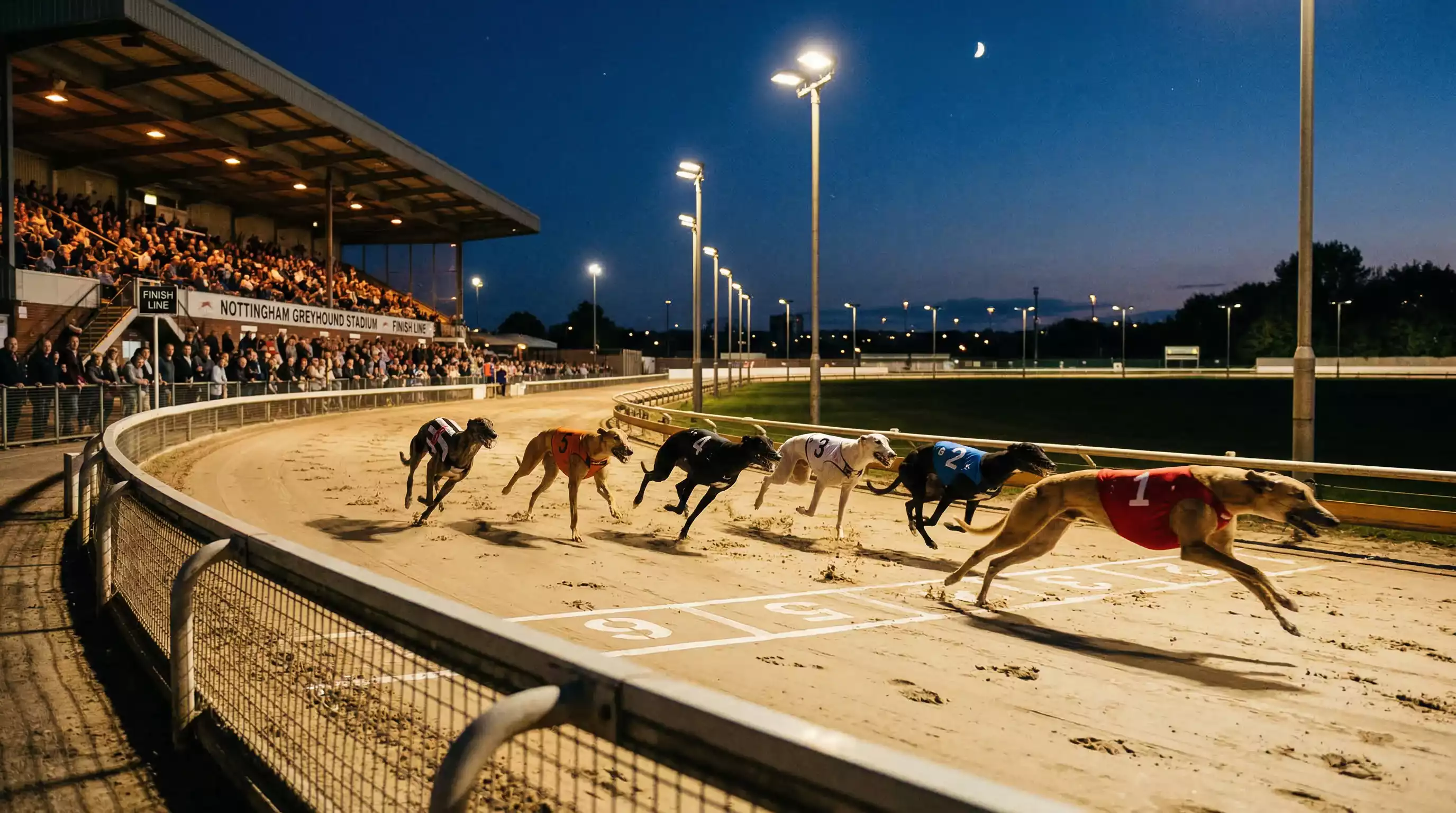
Nottingham Greyhound Stadium: Why It Matters for UK Dog Racing
Nottingham dog results tell a story that stretches back over four decades, through thousands of races on one of the most distinctive ovals in British greyhound racing. Situated at Colwick Park on the eastern edge of the city, Nottingham Greyhound Stadium has quietly built a reputation as a data-rich, analytically fascinating venue, and one that rewards punters who take the time to understand its quirks. Whether you are checking tonight's card for the first time or you have been following the dogs here since the track opened in 1980, this guide is designed to give you every number, every angle, and every insight that matters.
The UK greyhound racing landscape has contracted sharply since the sport's mid-century peak. In the 1940s, the country hosted 77 licensed tracks and over 200 independent venues. By January 2025, just 18 GBGB-licensed stadiums remained in operation across Great Britain. That statistic alone should tell you something about survivorship: the tracks that endure are the ones that adapt, invest, and deliver consistent racing product. The registered sector today encompasses approximately 500 trainers, 15,000 owners and around 6,000 greyhounds registered annually for racing, all operating under GBGB regulation. Nottingham sits comfortably in that category. It is one of the busiest venues in the central region, running four sessions per week and hosting four Category 1 competitions annually, the highest tier in the sport's calendar.
The timing could hardly be more significant. Greyhound racing in the United Kingdom celebrates its centenary in 2026, a milestone that has prompted the industry to take stock of both its heritage and its future direction. The sport's digital footprint has grown considerably: Greyhound Racing UK reported more than 10 million digital views in 2025, a figure that reflects rising interest in online streaming and archive content. For Nottingham specifically, the centenary season arrives on the back of a strong period. The stadium was acquired by Arena Racing Company in 2020, folded into the Premier Greyhound Racing joint venture with Entain, announced in 2021 and launched in January 2024, and awarded the prestigious St Leger for the first time in 2025. The trajectory has been upward.
This article serves as a comprehensive reference for anyone serious about interpreting Nottingham dog results. We cover the full picture: how to find results in real time, what the race schedule looks like week by week, the technical specifications of every distance on the 437-metre oval, how to decode form and running comments, which traps carry a statistical advantage, how the major competitions fit together, where to place a bet and what to look for, and what you need to know before visiting Colwick Park in person. Every claim in these pages is grounded in verifiable data from first-party sources, official industry bodies, and peer-reviewed research. No guesswork, no filler, just the information that matters.
What Every Punter Should Know About Nottingham Dogs
- Nottingham runs four sessions per week: Monday and Friday evenings from 17:56, Wednesday and Thursday mornings from 10:54. The track hosts four Category 1 events each year, including the Select Stakes with a record prize of £12,500.
- The 437-metre oval offers nine racing distances from 305m sprints to 925m marathons, with the first bend arriving at 85 metres on the standard 500m trip.
- Trap 1 wins 18 to 19 percent of races against a theoretical expectation of 16.6 percent, a bias confirmed by academic research and worth factoring into every selection.
- Live coverage flows through Premier Greyhound Racing via Ladbrokes, Coral, William Hill, Paddy Power and Betfred. Sky Sports Racing and At The Races carry selected meetings.
- UK greyhound betting turnover stood at £794 million for 2023 to 2024, and favourites win roughly 30 percent of the time, meaning value exists for punters who do their homework.
How to Find Today's Nottingham Greyhound Results
Checking Nottingham greyhound results today is straightforward once you know where to look, but the sheer number of platforms can make the first attempt feel more complicated than it needs to be. The key distinction every new follower should understand is the difference between fast results and full form. One gives you a snapshot, the other gives you the tools to handicap the next meeting.
Live and Fast Results Platforms
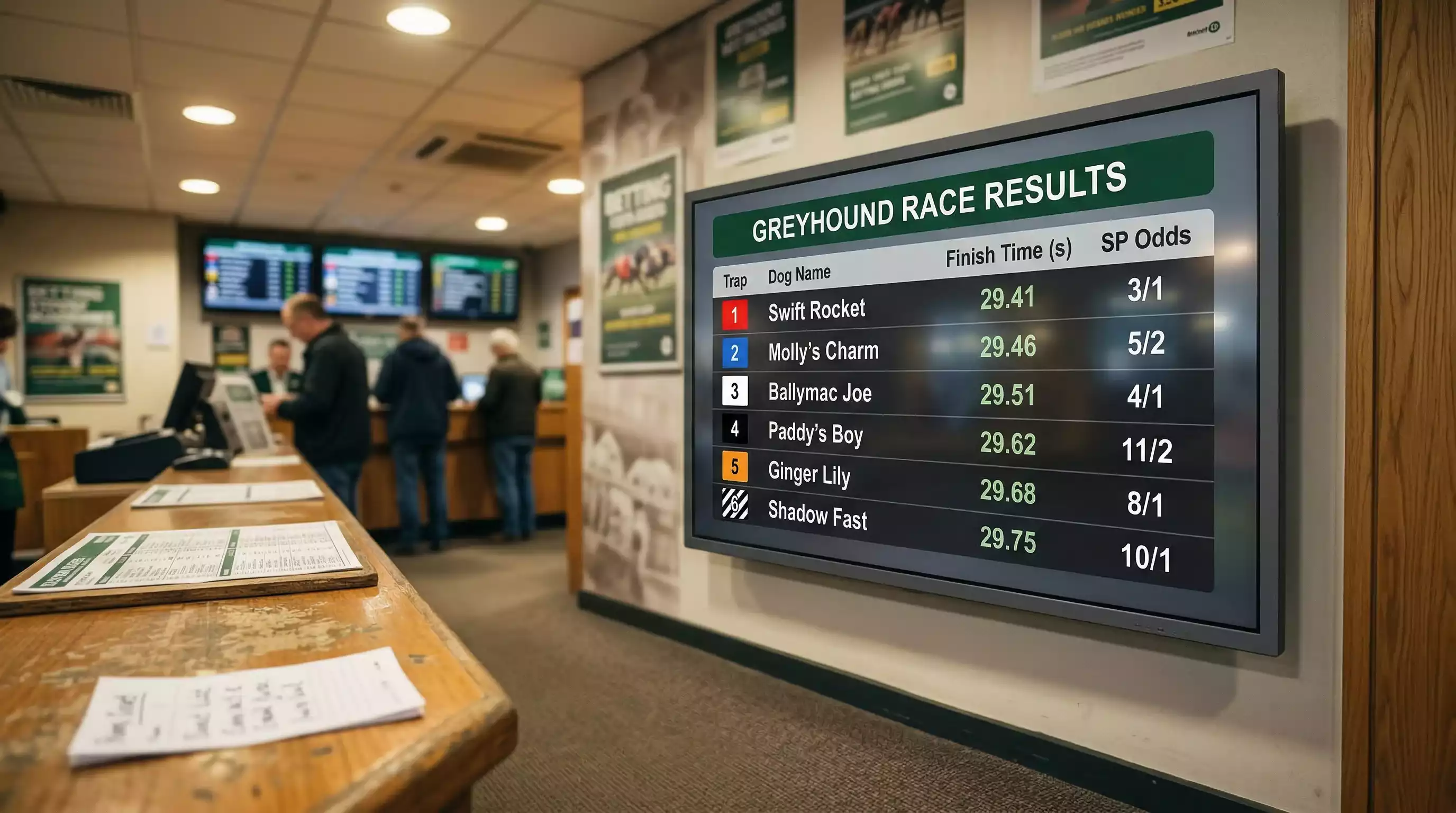
The quickest way to see Nottingham results as they happen is through the Premier Greyhound Racing feeds distributed to the major retail bookmakers. Since PGR holds exclusive media rights for Nottingham through its joint venture between Entain and Arena Racing Company, the primary live data flows through the five largest UK operators. Each shows race-by-race results within seconds of the official judge's declaration, typically displaying trap number, dog name, finishing time, starting price, and the forecast and tricast dividends.
Beyond the bookmakers, two dedicated broadcast platforms carry Nottingham content. SIS (Satellite Information Services) provides the feed for daytime BAGS meetings, which at Nottingham means the Wednesday and Thursday morning sessions. At The Races, accessible online through attheraces.com, carries selected evening fixtures and provides a replay service for races that have already been run. Sky Sports Racing (channel 415 on Sky) also picks up certain Nottingham meetings, particularly when Category 1 competitions are scheduled.
For punters who simply want the numbers without the video, Greyhound Racing UK maintains a digital archive that covers every licensed track. The Sporting Life and Racing Post also publish Nottingham results, typically updated within minutes of each race finishing. These sources are useful when you need to cross-reference results from a specific date or check a dog's performance history across multiple meetings.
Understanding the Data Format
A standard Nottingham result line includes several fields that newcomers often overlook. The trap number, shown as a colour-coded position from 1 (red) through 6 (black), tells you where the dog started. The finishing time is the official clock time for the distance, which can be compared against the calculated time, a figure adjusted for going conditions, to give a truer picture of performance. Starting price (SP) is the final odds at which the dog was available at the off. Forecast returns show the payout for correctly predicting first and second in order, while tricast returns cover first, second and third.
What fast results typically omit is the sectional-time data and running comments that appear in full form. Sectional times break the race into segments, revealing whether a dog led early and faded or came from behind to finish strongly. Running comments use shorthand abbreviations like SAw (slow away), EP (early pace), Crd (crowded) and QAw (quick away) to describe what happened during the race. We cover these in detail in the form-reading section below.
When Results Are Published
Nottingham's regular weekly schedule runs across four days: Monday and Friday evenings, with the first race typically at 17:56, and Wednesday and Thursday mornings, with first race times around 10:54. Results from evening meetings are usually fully indexed on archive platforms by midnight, while morning session results are available by early afternoon. If you are planning to use yesterday's results for tonight's card, the full form data, including sectional splits and going adjustments, normally takes a few hours longer to propagate than the raw finishing positions and times.
One practical tip: bookmaker apps often display results faster than dedicated racing sites, because the data feeds directly from SIS and PGR without an intermediary. If speed matters to your workflow, checking results through the app where you placed the bet is usually the most efficient approach.
Nottingham Race Days and Schedule: When the Dogs Run
Understanding the weekly rhythm of Nottingham's fixture list is essential for anyone who follows the track regularly. The schedule is not random. Each session occupies a specific slot that reflects the commercial structure of UK greyhound racing, and the character of the card changes depending on whether you are watching an evening Open Race meeting or a morning BAGS fixture.
Weekly Timetable
Nottingham races four days per week under normal circumstances. Monday and Friday are evening sessions, with the first race going off at 17:56. These are the flagship meetings, attracting the stronger graded dogs and drawing the largest on-course and streaming audiences. Wednesday and Thursday are morning sessions, with the first race typically scheduled for 10:54 on Thursdays. These daytime meetings are BAGS fixtures, contracted through the Bookmakers' Afternoon Greyhound Service, and are primarily aimed at the betting shop and online market rather than on-course spectators.
The distinction matters for form analysis. Evening meetings tend to feature higher-graded runners, more Open Races, and larger fields with stronger competition. BAGS meetings, by contrast, tend to feature more predictable graded racing, which can appeal to systematic bettors who rely on consistent form patterns. If you are studying Nottingham dog results with the goal of identifying value, knowing which type of meeting produced those results is a necessary first step.
Category 1 Events and Special Fixtures
Nottingham's fixture list in recent years has included four Category 1 competitions, the highest classification in the GBGB calendar. These are the BGBF Breeders' Stakes (typically March), the JenningsBet Puppy Classic and JenningsBet Select Stakes (August), and the Premier Greyhound Racing Eclipse (November). The Select Stakes reached a record prize of £12,500 in 2024, a figure matched by the Puppy Classic in the same year.
"It's been another bumper year at Nottingham Stadium with four new Category One champions crowned, including our recent Eclipse champion Newinn Syd. We're really pleased to begin 2024 with our popular Monday and Friday night racing slots continuing." — David Evans, General Manager, Nottingham Stadium
The 2025 season brought further prestige when Nottingham was awarded the St Leger for the first time, a development that cemented the stadium's position among the country's top-tier venues. Category 1 events are always televised and attract runners from across the country, making them the meetings most likely to produce headline results.
Seasonal Variations and Cancellations
While the Monday-Wednesday-Thursday-Friday pattern holds for most of the year, there are occasional adjustments. Bank holidays can shift meeting times or replace a regular session with a special afternoon card. Extreme weather, particularly heavy rain affecting the sand track surface, can lead to cancellations, though this is relatively rare at Nottingham, whose drainage system handles most conditions without issue. During the spring and summer months, the fixture list sometimes incorporates additional trial meetings ahead of major competitions, offering trainers the chance to give their dogs a preparatory run at the venue.
Checking the official Nottingham Greyhound Stadium website before travelling to the track remains the most reliable way to confirm that a meeting is going ahead as scheduled, particularly during winter months when frost and fog can cause late changes.
Track Distances and Records at Nottingham
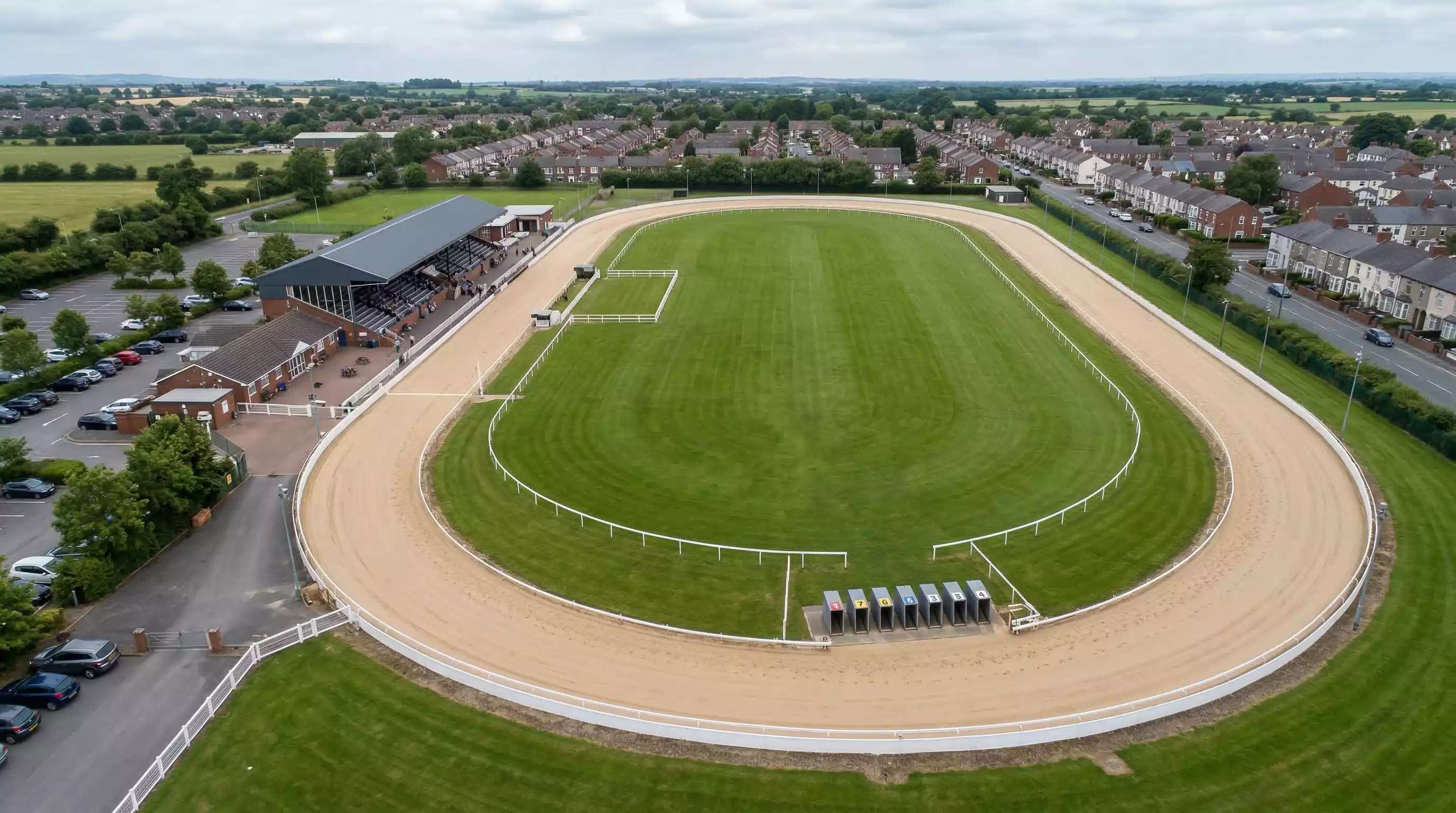
Nottingham Greyhound Stadium is built on a 437-metre circumference oval, a mid-sized configuration by UK standards. The track offers nine racing distances, ranging from the 305-metre sprint to the 925-metre marathon. That breadth of distances is unusual among British tracks and gives Nottingham a distinctive character: it accommodates pure speedsters, middle-distance grinders and stayers within the same programme. Understanding how each distance plays out on this particular oval is fundamental to interpreting Nottingham dog results accurately.
The Distance Menu
The following table shows every distance currently raced at Nottingham, along with the track record and the number of bends involved.
| Distance | Bends | Category | Track Record | Record Holder |
|---|---|---|---|---|
| 305m | 2 | Sprint | 17.32 | Romeo Steel |
| 480m | 4 | Standard | 28.50 | — |
| 500m | 4 | Standard | 28.95 | Proper Heiress |
| 680m | 4 | Middle | — | — |
| 700m | 6 | Middle | — | — |
| 730m | 6 | Stayer | — | — |
| 885m | 6 | Marathon | — | — |
| 905m | 6 | Marathon | — | — |
| 925m | 6 | Marathon | — | — |
The 500-metre trip is the bread-and-butter distance at Nottingham, used for the majority of graded and Open Race events. It involves four bends with the first turn arriving at the 85-metre mark, a relatively short run-up that places enormous emphasis on early pace and trap position. Dogs that break cleanly and reach the first bend in front have a tangible advantage here, which is one of the reasons trap statistics at Nottingham show the biases they do.
Sprints, Standards and Stayers
The 305-metre sprint is the shortest distance on the card and consists of just two bends. Sprint races at Nottingham are chaotic, fast-twitch affairs in which the first few strides effectively decide the outcome. The run to the first bend is particularly short, making trap draw critical. Romeo Steel holds the sprint record at 17.32 seconds, a time that reflects explosive early speed on a surface that rewards decisive acceleration.
Standard distances of 480 and 500 metres represent the core of Nottingham racing. Four bends mean four opportunities for trouble, but also four opportunities for a strong runner to make up ground. The 500-metre track record, held by Proper Heiress at 28.95 seconds, is a benchmark that most graded dogs will never approach. Calculated times on the 500m regularly fall between 29.5 and 30.5 seconds depending on grade and going conditions.
At the other end of the spectrum, the marathon distances of 885, 905 and 925 metres involve six or more bends and demand a completely different profile. Stayers need sustained pace rather than explosive speed, and the influence of trap draw diminishes with each additional bend. Positional racing, conserving energy on the bends and kicking clear on the straights, becomes the defining skill at these trips.
How the 437-Metre Circumference Shapes Racing
Nottingham's 437-metre circumference sits between the tighter ovals like Monmore Green (approximately 420 metres) and the wider sweeps of Towcester (460 metres). The practical effect is moderately tight bends that favour dogs running the rail, since inside runners cover less ground than those forced wide. This geometric reality, which applies to every race at every distance, is one of the reasons Trap 1 outperforms its theoretical win rate at Nottingham. It is worth holding this detail in mind whenever you are assessing results from the track: a dog that finished strongly from Trap 6 may have covered significantly more ground than the Trap 1 winner.
The first winner in Nottingham Greyhound Stadium history was a dog called Tartan Al, trained by W. Horton. On the evening of 24 January 1980, in front of more than 2,000 spectators, Tartan Al covered the 500 metres in 32.98 seconds at odds of 7/1. Modern greyhounds at the same distance are roughly four seconds faster, a measure of how far breeding, nutrition and track surfaces have advanced in just over four decades.
The hare system at Nottingham uses an outside-running Swaffham McGee, a widely used lure in British greyhound racing. The outside hare means the field breaks towards the rail from the traps, which further reinforces the positional advantage of dogs drawn on the inside. Trainers and punters who understand this dynamic are better equipped to interpret split times and race patterns at Nottingham than those who view results in a vacuum.
How to Read Nottingham Greyhound Form and Results
Raw results only become useful once you can read the form that sits behind them. Nottingham greyhound form contains a dense layer of abbreviated information that describes not just how a dog finished, but how it ran the race. Decoding this data is the single most important skill for anyone who wants to move beyond casual punting and start making selections based on evidence.
Trap Colours and Their Significance
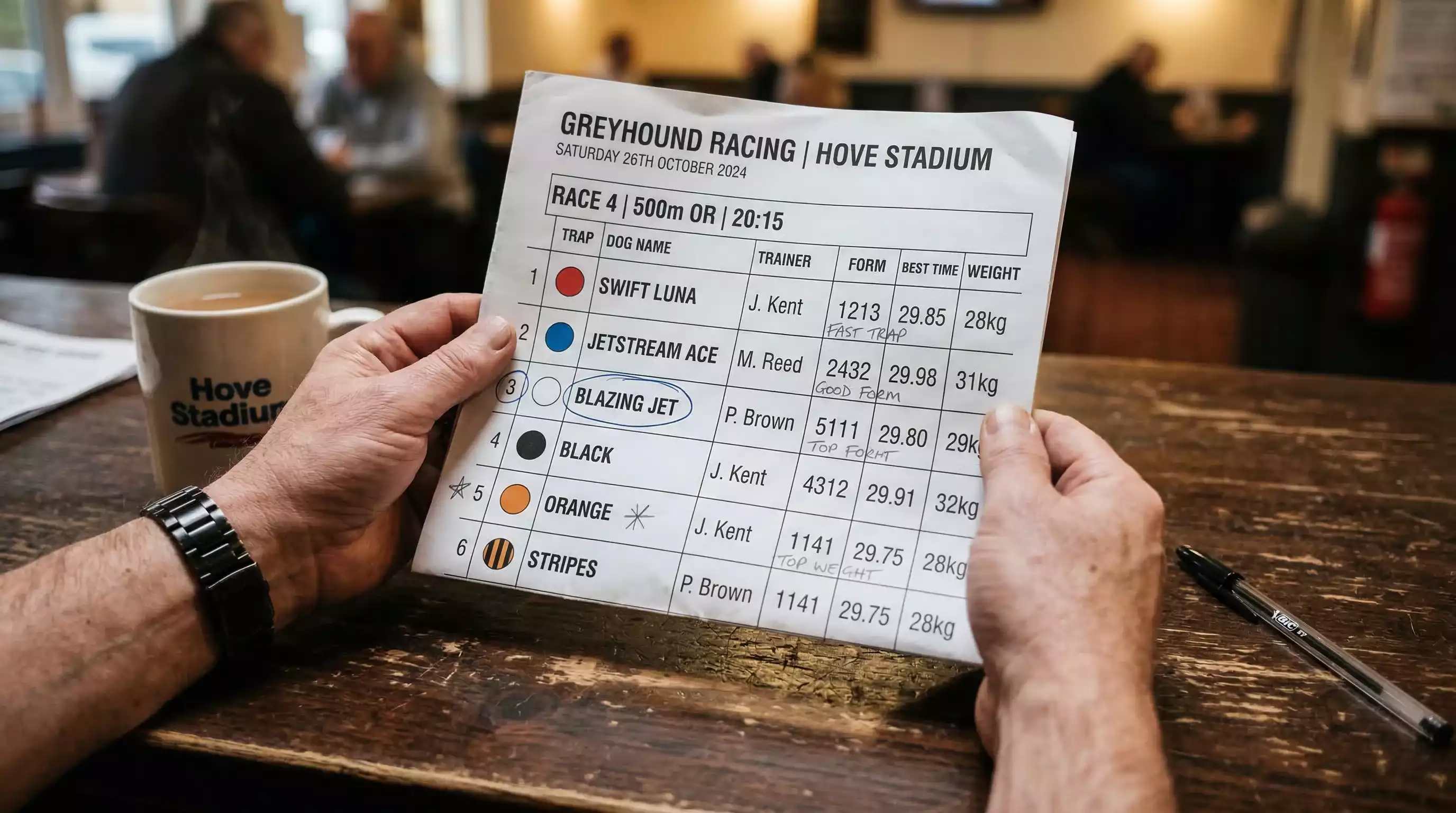
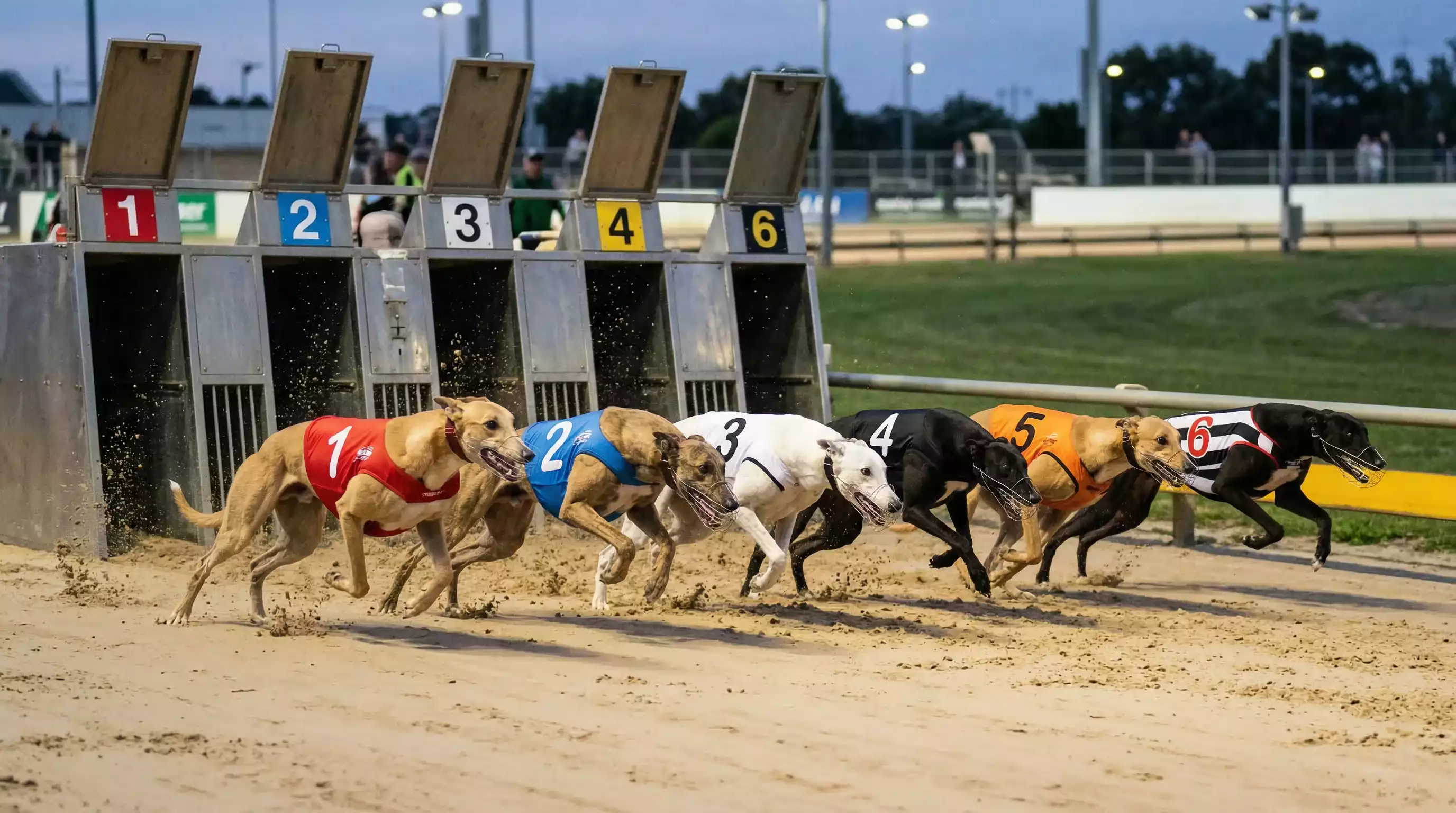
Every greyhound at Nottingham wears a coloured jacket corresponding to its trap number. Trap 1 is red, Trap 2 is blue, Trap 3 is white, Trap 4 is black, Trap 5 is orange, and Trap 6 is black and white striped. This colour system is universal across GBGB tracks, but the significance of trap position varies by venue. At Nottingham, the 85-metre run to the first bend on the 500m trip means that inside traps, particularly Trap 1, carry a measurable statistical edge. When reading form, always note which trap a dog occupied in its previous runs, because a good time from Trap 1 and an equally good time from Trap 6 do not represent the same level of performance.
Form Abbreviations Decoded
The running comments that accompany each result use a standardised set of abbreviations. Understanding these is non-negotiable for serious form students. Here are the most common abbreviations you will encounter in Nottingham results:
- SAw — Slow away. The dog missed the break from the traps.
- QAw — Quick away. A clean, fast start.
- EP — Early pace. The dog showed speed in the opening section.
- ALed — Always led. The dog led from trap to line without being headed.
- Crd — Crowded. The dog was impeded by other runners during the race.
- Bmp — Bumped. Physical contact with another dog.
- RnUp — Ran up. The dog closed ground in the finishing straight.
- W — Wide. The dog raced wide of the rail, covering more ground.
- Ck — Checked. The dog had to alter course or slow down due to interference.
- Led2 — Led at the second bend. Indicates early positional strength.
These abbreviations form a narrative of the race. A dog described as "QAw, EP, ALed" broke cleanly, showed early speed and controlled the race throughout. That is a very different profile from a dog marked "SAw, Crd, RnUp", which missed the break, was impeded, and only managed to close late. Both dogs might have finished within half a length of each other, but the first profile suggests consistency while the second suggests bad luck that could reverse on another night.
Sectional Times and What They Reveal
Sectional times break a race into segments, typically measuring the time to the first bend and the split for the run-in. At Nottingham, with its first-bend distance of 85 metres on the 500m trip, the opening sectional tells you how quickly a dog reached the first turn. Dogs with fast opening sectionals but slower overall times are burning energy on the bends, possibly running wide. Dogs with moderate opening sectionals but strong finishes may be rail runners who conserve ground. This detail is invisible in the headline result but transformative for handicapping.
Calculated Time Versus Actual Time
One of the most misunderstood elements in Nottingham form is the distinction between actual time and calculated time. Actual time is the raw clock reading from trap release to crossing the finishing line. Calculated time adjusts this figure for the going, a correction factor that accounts for the condition of the sand surface on the day. If the going was running slow, the calculated time will be faster than the actual time, reflecting what the dog would have run under normal conditions. If the going was fast, the calculated time will be slower.
Why does this matter? Because comparing actual times across different meetings is misleading. A dog that clocked 30.10 seconds on a slow track may have produced a better performance than one that ran 29.80 on a fast surface. Calculated times level the playing field. When you are scanning Nottingham dog results across multiple dates, always compare calculated times rather than actual times. This single adjustment will improve the accuracy of your form assessments more than any other technique.
Going Allowance at Nottingham
The going allowance at Nottingham varies from meeting to meeting and is published by the racing office before the first race. It is expressed as a positive or negative adjustment in hundredths of a second. A going allowance of +20, for example, means the track is running 0.20 seconds slow, so 0.20 seconds would be subtracted from each actual time to produce the calculated time. Monitoring how the going changes across a meeting is also informative: if the first few races run on a going allowance of +10 but later races show +25, the surface has deteriorated, and dogs drawn in later races may have been at a structural disadvantage.
An academic study published in PMC (PubMed Central) confirmed that dogs running closest to the rail, predominantly those breaking from Box 1, cover the least distance over the course of a race. This geometric advantage is baked into the results. When reading form, dogs that consistently run the rail will tend to produce faster calculated times relative to their actual ability, a subtle but important distinction that affects value assessment.
Major Competitions at Nottingham Greyhound Stadium
Nottingham is not just a busy workaday venue. It is a Category 1 stadium, which means it hosts the most prestigious competitions in the GBGB calendar. For context, total prize money across British greyhound racing stands at £15,737,122, with the English Greyhound Derby alone carrying a winner's purse of £175,000. Nottingham's share of that prize pool has grown steadily, and the four Category 1 events now staged at the track represent a significant concentration of quality racing at a single venue.
The JenningsBet Select Stakes
The Select Stakes is Nottingham's marquee event. In 2024, the winner's prize reached a record £12,500, the highest in the competition's history and a milestone that reflected both increased sponsorship and the broader investment flowing into the track through the Premier Greyhound Racing partnership.
"A lot of interest has been generated around this year's Select Stakes and Puppy Classic. With the night coinciding with National Greyhound Week, we're planning an evening full of additional activities so our regular and casual racegoers can be at the heart of the action and enjoy a fun, family friendly, night out." — David Evans, General Manager, Nottingham Stadium
The Select Stakes typically features a field of elite open-race greyhounds competing over the standard 500-metre trip. Because the event attracts runners from across the country, the form lines it produces are among the most reliable indicators of absolute class at Nottingham. Winners of the Select Stakes in recent years have gone on to compete in Category 1 events at other venues, making the results a useful benchmark for cross-track comparison.
The JenningsBet Puppy Classic
Run alongside the Select Stakes, usually on the same August fixture, the Puppy Classic carries identical prize money of £12,500. It is restricted to younger dogs, giving trainers an opportunity to test emerging talent against top-level opposition. Puppy Classic results are particularly interesting from a handicapping perspective because they reveal which kennels are producing fast dogs early in their careers. A strong showing here often forecasts future graded or open-race success at Nottingham and beyond.
The Premier Greyhound Racing Eclipse
The Eclipse, staged in November, is one of the final Category 1 events of the Nottingham season. It tends to attract dogs in peak form heading into the winter months and produces fast times on a track that typically runs well during the autumn period. The recent Eclipse winner, Newinn Syd, highlighted the quality of competition that the event draws.
The BGBF Breeders' Stakes
The Breeders' Stakes, usually held in March, opens the Category 1 calendar at Nottingham. It celebrates the breeding side of the sport, with eligibility restricted to dogs whose connections have paid into the BGBF levy system. The event functions as an early-season indicator of which lines are producing competitive greyhounds and offers an interesting window into the genetics that underpin performance on the 437-metre oval.
The St Leger: A New Chapter
In a significant development for the venue, Nottingham was awarded the St Leger in 2025, one of the sport's most historic races. The St Leger is traditionally run over a stayer's distance, bringing marathon racing to the forefront of the Nottingham programme. Its addition to the fixture list cements the stadium's status as a venue capable of hosting the very highest calibre of competition.
The Greyhound Derby Connection
Nottingham also has a notable link to the English Greyhound Derby, which was staged at the track in 2019 and 2020 when its usual home was unavailable. Hosting the Derby, the richest race in British greyhound racing, gave Nottingham national prominence and demonstrated that the facility could handle the demands of the sport's showpiece event. The Premier Greyhound Racing joint venture has invested more than £2.5 million into Open Race prize money across its portfolio of venues, including Nottingham, further raising the profile of competition at the stadium.
Nottingham Trap Statistics: Which Trap Wins Most?
In a six-trap race, a perfectly balanced track would see each trap win approximately 16.6 percent of the time. Nottingham is not a perfectly balanced track, and the deviation from that theoretical baseline is one of the most exploitable patterns in British greyhound racing. Understanding trap bias at Nottingham is not optional for serious punters. It is structural, it is measurable, and it should inform every selection you make.
The Trap 1 Advantage
Data compiled by The Game Hunter shows that Trap 1 at Nottingham wins between 18 and 19 percent of races across all distances, roughly two to three percentage points above the expected rate of 16.6 percent. That may not sound dramatic, but over hundreds of races it represents a consistent, statistically significant edge. The explanation is largely geometric. Dogs breaking from Trap 1 are closest to the inside rail and therefore cover the shortest distance around every bend. On a 437-metre oval with relatively tight turns, the saving in ground covered is meaningful.
This advantage is not a Nottingham quirk. An academic study published in PMC (PubMed Central) examined box-draw effects in greyhound racing and found that Box 1 had a statistically significant positive effect on finishing position. The same study identified middle and outer boxes as having statistically significant negative effects. While the research was conducted on Australian tracks with eight-box starts, the underlying geometric principle applies to Nottingham's six-trap format: rail runners cover less ground, and at Nottingham the short 85-metre run to the first bend on the 500m trip means that inside dogs have less time to lose their positional advantage before the field compresses into the first turn.
Trap Bias by Distance
The strength of the Trap 1 bias is not uniform across all distances. On the 305-metre sprint, the advantage is at its most pronounced. With only two bends and an extremely short run-up, the inside trap offers both a shorter path and a protected rail position for the entire race. Dogs drawn in Trap 6 must either break faster than everything else or risk being swept wide on the first bend, losing irretrievable ground in a race that lasts less than 18 seconds.
On the standard 500-metre trip, the bias persists but becomes slightly less extreme. Four bends give wide runners more opportunities to find a path back to the rail, and a strong finisher can sometimes overcome an unfavourable draw by making ground on the long back straight. Still, Trap 1 retains a clear edge over Traps 4 and 5, which tend to get squeezed in the first few strides.
Over stayer distances of 680 metres and beyond, the trap draw becomes progressively less decisive. More bends mean more reshuffling, and the sustained-pace demands of marathon trips often favour dogs with superior stamina regardless of where they started. However, even at 925 metres, a rail-running style remains an advantage because the cumulative distance saving over six or more bends can amount to several metres. The bias fades, but it never disappears entirely.
Trap 1 at Nottingham wins 18 to 19 percent of all races, roughly two to three points above the theoretical expectation. This bias is strongest in the 305-metre sprint and weakest over marathon distances, but it persists across the board. When two dogs look evenly matched on form, the one drawn in Trap 1 has the structural edge.
Using Trap Data Practically
Trap statistics should be one input among several, not the sole basis for a selection. A Trap 1 runner with deteriorating form and a step up in grade is not automatically a bet just because the inside draw offers a geometric advantage. The real value of trap data lies in tiebreaking: when two or three dogs look comparable on recent times, weight and form, the trap draw can tip the balance. It is also useful for ruling dogs out. A slow starter drawn in Trap 5, one of the historically weakest positions, faces a compounding disadvantage: a poor start from a poor draw on a track that punishes both.
Smart punters combine trap stats with sectional-time analysis and running-style profiling. A dog that consistently shows early pace and rails through from Trap 1 is exploiting the bias at maximum efficiency. A dog that habitually runs wide and finishes strongly from Trap 6 may be producing better raw performances than its finishing positions suggest. Trap data provides context, and context is what separates informed betting from guesswork.
Betting on Nottingham Dogs: Odds, Types & Where to Bet
Greyhound racing remains a substantial part of the UK betting economy. According to Gambling Commission data, betting turnover on greyhound racing in British bookmakers reached £794 million for the period April 2023 to March 2024. That figure reflects both over-the-counter bets in high-street shops and online wagers placed through licensed operators. Nottingham, as one of the most active tracks in the PGR network, accounts for a significant slice of that volume across its four weekly meetings.
Types of Bets Available
Betting on Nottingham dogs follows the standard UK greyhound wagering menu, but each bet type carries different risk-reward characteristics that are worth understanding before you put money down.
Win: The simplest bet. You back a dog to finish first. If it does, you collect at the starting price or at the fixed odds you took. If it finishes second or worse, you lose. Win bets are the foundation of most punting strategies and the easiest to evaluate against form data.
Each-way: An each-way bet is effectively two bets in one: a win bet and a place bet. In a standard six-runner greyhound race, bookmakers typically pay out the place portion at one-quarter of the win odds for first and second place. Each-way betting is particularly useful when you fancy a dog to run well but are not fully confident it will win, a common scenario at Nottingham where the tight first bend can cause trouble for even well-fancied runners.
Forecast: A forecast requires you to predict the first two dogs home in the correct finishing order. Straight forecasts pay well because the probability of correctly naming both finishers in sequence is low. Reverse forecasts cover both possible orderings of your two selections, doubling the cost but increasing the chance of a return.
Tricast: The tricast takes forecasting one step further. You must predict the first three finishers in exact order. Tricast dividends can be substantial, often running into hundreds or even thousands of pounds from a small stake, but hitting one consistently is extremely difficult. Some systematic bettors use tricast perming, where they select four or five dogs and cover all possible combinations, though the stake cost rises quickly with each additional dog included.
Best Odds Guaranteed and Price Comparison
Most major UK bookmakers now offer Best Odds Guaranteed (BOG) on greyhound racing, including Nottingham fixtures. BOG means that if you take a fixed price and the starting price is higher, the bookmaker pays out at the better price. This is a straightforward advantage for the punter and eliminates the risk of backing a dog early only to see the price drift further out.
Across UK tracks, favourites win approximately 30 percent of races. That figure holds reasonably well at Nottingham, which means that seven out of ten races are won by a dog that was not the shortest-priced runner. The implication is clear: there is value to be found in the market, but only if you can identify when the public and the bookmakers have got a dog wrong. Comparing prices across multiple operators before placing a bet is one of the simplest ways to add value to your betting, and several price-comparison tools specific to greyhound racing are available online.
Where to Bet on Nottingham Dogs
Since the launch of the Premier Greyhound Racing joint venture in January 2024, the primary operators carrying Nottingham live content are Ladbrokes, Coral, William Hill, Paddy Power and Betfred. All five offer pre-race betting markets on Nottingham fixtures, live streaming of races to funded account holders, and fast settlement of results. Independent online bookmakers and the Tote (pool betting) also cover Nottingham meetings, offering an alternative pricing structure that can sometimes deliver better returns, particularly on forecast and tricast bets.
"As important as greyhound racing is to the betting industry as a whole, greyhounds have always been a fundamental part of the betting shop service." — Mark Kingston, Director, Premier Greyhound Racing
Bookmaker revenue from greyhound racing flows back to the sport through the British Greyhound Racing Fund. BGRF receives voluntary contributions from bookmakers at a rate of 0.6 percent of greyhound betting turnover, a mechanism that generated £6.75 million in the 2024 to 2025 period. That funding supports prize money, welfare programmes and track maintenance across all licensed venues, including Nottingham.
Interactive Tool
BGRF Implied Turnover Check, and Track Record Progress
Back-calculate the turnover implied by the BGRF's 0.6% contribution rate, and see the exact time gap between Nottingham's first winner and its current record.
Implied Turnover
-
-
Contribution
-
Prior Year Figure
-
Implied Growth
-
What this guide states as two unconnected figures: "betting turnover... reached £794 million for the period April 2023 to March 2024" and separately "BGRF... at a rate of 0.6 percent... generated £6.75 million in the 2024 to 2025 period." Back-calculating the turnover implied by that contribution gives £1,125 million — a 41.7% jump year-on-year that the guide never flags or reconciles.
Exact Time Improvement
-
-
Tartan Al (1980)
-
Proper Heiress (Record)
-
Percent Faster
-
What this guide only approximates: "Tartan Al covered the 500 metres in 32.98 seconds" in 1980, and "Modern greyhounds at the same distance are roughly four seconds faster." The exact gap is never stated — it's 4.03 seconds, a 12.2% improvement over 45 years to the current record of 28.95.
Streaming Access Through Bookmakers
One of the underappreciated benefits of having a funded account with a PGR-linked bookmaker is free live streaming of every Nottingham meeting. Most operators require only a small deposit or a placed bet on the meeting to unlock the stream. The video quality is broadcast-grade, sourced from the same SIS feeds that supply betting shops, and includes commentary, trap colours, and starting-price updates. For punters who study form visually, watching the races live or on replay is a far richer source of information than the abbreviated text-based form lines.
Responsible gambling reminder: Greyhound racing is fast-moving and can encourage impulsive betting, particularly when results come every few minutes during a meeting. Set a budget before the first race. Stick to it regardless of whether you are winning or losing. If you feel that your betting is no longer enjoyable or is causing financial stress, organisations such as GamCare and BeGambleAware offer free, confidential support. Never chase losses.
Visiting Nottingham Greyhound Stadium: Colwick Park Guide
Nottingham Greyhound Stadium occupies a site within the Colwick Park complex, roughly two miles east of the city centre. The stadium sits adjacent to Nottingham Racecourse, the horse-racing venue, and benefits from the shared infrastructure of a well-established sporting estate. Whether you are making your first visit or returning after a break, here is everything you need to know about the practical side of an evening at the dogs.
Address: Nottingham Greyhound Stadium, Colwick Park, Nottingham, NG2 4BE
Capacity: 1,500 spectators
Parking: On-site car park for approximately 1,000 vehicles (free)
Getting there by road: Follow the A612 from the city centre towards Colwick. The stadium is signposted from the main road.
Getting there by tram: The NET tram network does not extend to Colwick Park. The nearest tram stop is Nottingham Station, approximately two miles from the stadium. From the city centre, Nottingham City Transport bus routes 44 and 44A run directly to Colwick Racecourse Park and Ride, a short walk from the greyhound stadium entrance.
Admission: Adult entry varies by meeting type. Children are typically admitted for £1.
Dress code: Smart casual. No strict dress code, but the restaurant area may have specific requirements on busier evenings.
What to Expect On-Course
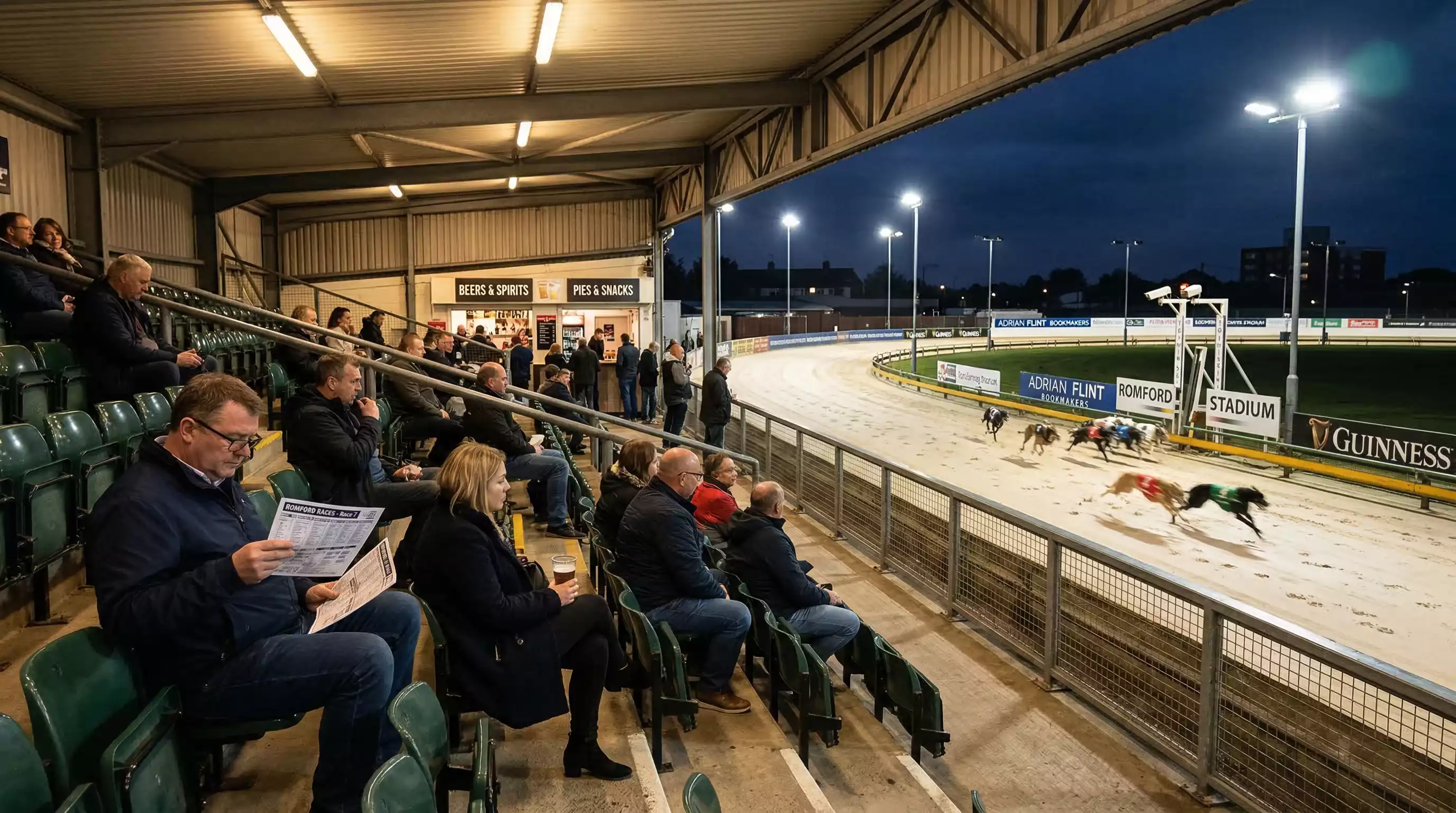
The stadium holds up to 1,500 spectators with parking for around 1,000 cars, which means it never feels overwhelmingly crowded even on major event nights. The main viewing area is a covered grandstand with tiered seating overlooking the finishing straight. Below that, the open terrace offers a closer-to-the-action experience for those who prefer to stand. A licensed bar, food outlets and a sit-down restaurant are all within the facility, and the restaurant packages that include a meal, racecard and reserved seating are a popular option for first-time visitors and group bookings.
Racecards are available on arrival and include all the form information discussed earlier in this guide. Tote betting facilities are available on-course alongside standard bookmaker pitches, giving racegoers the option to bet directly at the venue as well as through their phone.
A Brief History of the Venue
Nottingham Greyhound Stadium opened on 24 January 1980 under the name Colwick Park. The inaugural meeting drew more than 2,000 spectators, a strong debut that established the track as a viable addition to the Midlands racing circuit. For decades the stadium operated under independent ownership, building a loyal local following and occasionally hosting high-profile events.
The modern era at Nottingham began in 2020 when Arena Racing Company acquired the venue. ARC's purchase brought Nottingham into a larger portfolio of racing assets and opened the door to the Entain media-rights deal signed in 2021, which launched the Premier Greyhound Racing joint venture in January 2024. Under PGR, Nottingham's content is distributed to every major high-street bookmaker in the country, significantly expanding the audience for each meeting. The addition of the St Leger to the fixture list in 2025 was the most visible marker of the track's rising ambitions.
Through all these changes, the core appeal has remained the same: a compact, well-maintained oval with an atmosphere that blends competitive racing with a relaxed social setting. Nottingham is not trying to be a mega-stadium. It is trying to be a very good greyhound track, and on that measure it delivers consistently.
Frequently Asked Questions About Nottingham Dogs
What days and times does Nottingham Greyhound Stadium race?
Nottingham runs four sessions per week. Monday and Friday evenings are the main meetings, with the first race typically off at 17:56. Wednesday and Thursday are morning sessions, primarily BAGS fixtures for the betting-shop market, with Thursday's first race at 10:54. Evening meetings tend to feature higher-graded runners and Open Race competition, while morning sessions offer more predictable graded racing. The schedule is broadly consistent throughout the year, though bank holidays and special fixtures can occasionally alter the normal pattern. Category 1 events, of which there are four per year, always take place on evening cards and are televised through Sky Sports Racing and the PGR streaming network. If you are planning to attend in person, checking the official Nottingham Greyhound Stadium website on the day is always advisable, as late cancellations due to weather, though rare, can happen during winter months.
What distances are available at Nottingham and what are the track records?
Nottingham offers nine racing distances on its 437-metre circumference oval: 305m, 480m, 500m, 680m, 700m, 730m, 885m, 905m and 925m. The most commonly raced distance is 500 metres, which involves four bends with the first turn at the 85-metre mark. The 305-metre sprint record is held by Romeo Steel at 17.32 seconds, while the 500-metre record belongs to Proper Heiress at 28.95 seconds. The track uses an outside-running Swaffham McGee hare. Sprint distances of 305m are two-bend affairs that favour explosive early speed and inside trap draws. Standard distances of 480m and 500m are four-bend races that balance speed with positional racing. Marathon distances from 885m upwards involve six or more bends and demand genuine stamina. The variety of distances at Nottingham means that different types of dogs can find their niche at the track, from flat-out sprinters to grind-it-out stayers.
How do I read Nottingham greyhound form and result abbreviations?
Nottingham greyhound form uses standard GBGB abbreviations that describe how a dog ran during a race. The most important abbreviations to learn are SAw (slow away, meaning the dog missed the break), QAw (quick away, a clean start), EP (early pace, showing speed in the opening section), ALed (always led, the dog was never headed), Crd (crowded, indicating interference from other runners), Bmp (bumped, direct physical contact), and RnUp (ran up, closed ground late). Beyond the running comments, form data includes the trap number and colour, finishing time, starting price, and the going allowance for that meeting. The critical distinction for accurate handicapping is between actual time and calculated time. Actual time is the raw clock reading, while calculated time adjusts for the going conditions on the day. Always use calculated times when comparing performances across different meetings, because a 30.00-second clock on a slow track is a better run than a 29.80 on fast going. Sectional times, where available, reveal the pace pattern of a race and are particularly useful for identifying dogs whose finishing positions do not reflect their true ability.
