

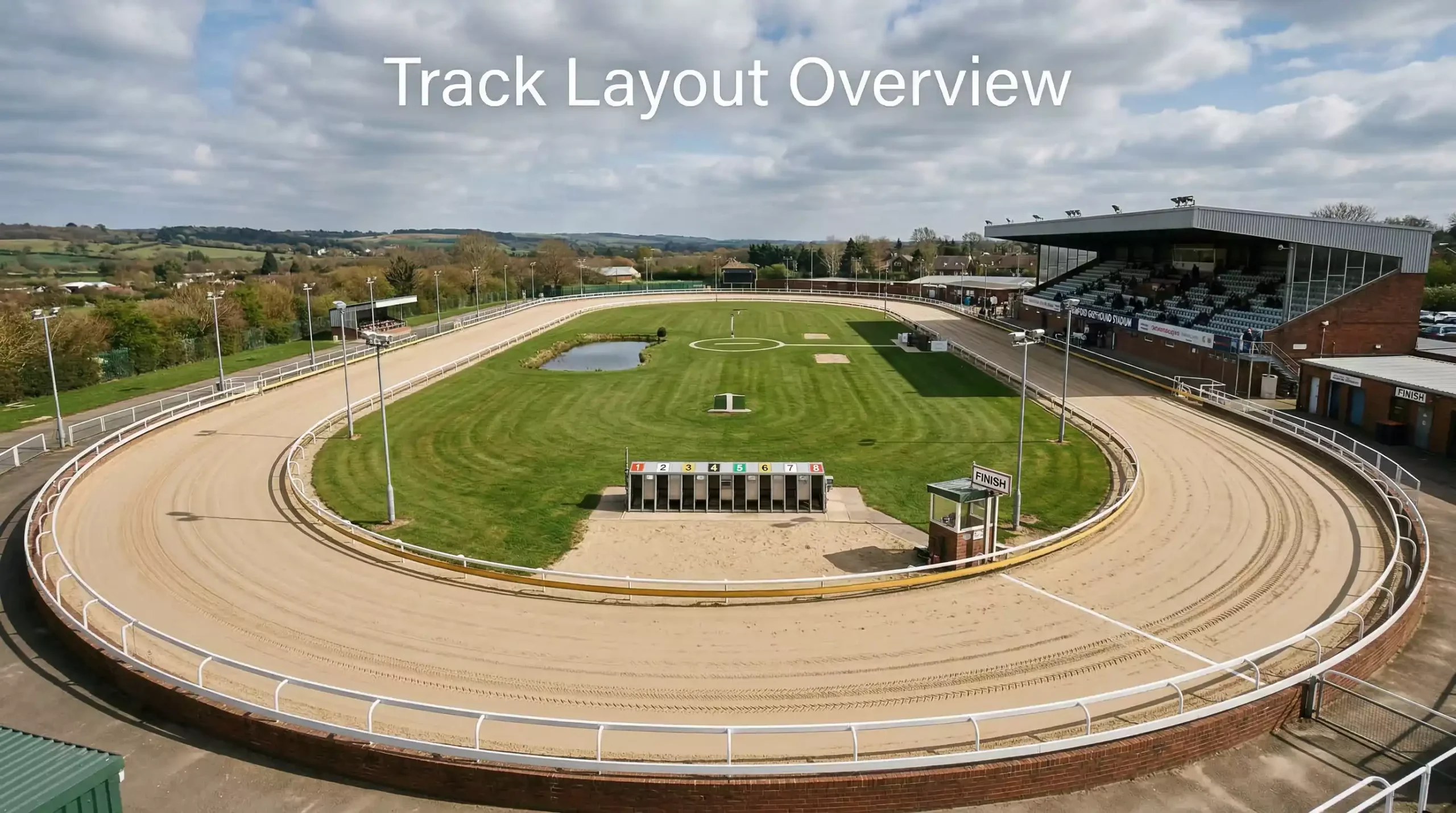
The Eighteen GBGB Stadiums Still Racing in the UK
UK greyhound tracks number just eighteen licensed GBGB stadiums in 2026 — a figure that represents one of the most dramatic contractions in British sporting history. In the 1940s, when greyhound racing sat alongside football and cricket as a pillar of working-class entertainment, 77 licensed tracks operated across the country, with more than 200 independent venues running alongside them. The post-war decline was gradual at first, then accelerated sharply from the 1990s onwards as land values rose, attendances fell, and competing entertainment options multiplied.
The tracks that survive are spread across England — there are no licensed stadiums currently operating in Wales, Scotland, or Northern Ireland. Each venue has its own circumference, surface type, distance menu, and character. Some are compact sprinters’ tracks; others favour stayers with long straights and sweeping bends. Knowing the differences matters for punters, because a dog’s form at one track doesn’t automatically translate to another.
What follows is a guide to every licensed GBGB stadium operating in 2026, including the three that closed and the one that opened in 2025.
Every Licensed Track: Location, Circumference and Key Distances
The eighteen licensed stadiums break naturally into regional clusters, each serving a different catchment area for punters, trainers, and dogs.
In London and the Southeast, Romford remains the capital’s primary greyhound venue following the closure of Crayford in 2025. Romford operates a tight circuit popular with sprint specialists and draws a loyal crowd on its regular evening meetings. It’s a Premier Greyhound Racing stadium, which means its races are broadcast through the PGR network to all major bookmakers. Further south, Central Park in Kent and Hove in Sussex provide additional options along the coast, each with its own character and regular meeting schedule.
The Midlands is the strongest region for greyhound racing density. Nottingham, Monmore Green (Wolverhampton’s long-standing venue), and the newly opened Dunstall Park form a triangle of tracks within easy driving distance of each other. Hall Green in Birmingham adds a fourth option, though the closure of Perry Barr in 2025 reduced the region’s total. Dunstall Park’s opening partially compensated for that loss, bringing a modern facility to the Wolverhampton area and demonstrating that new investment in greyhound infrastructure is still viable.
In the North, Belle Vue in Manchester carries historical significance as the city’s primary greyhound venue and one of the sport’s oldest surviving locations. Doncaster, Kinsley, and Sheffield provide further coverage across Yorkshire and South Yorkshire, while Newcastle-under-Lyme and Sunderland serve the Northeast and the Potteries. These northern tracks tend to run BAGS meetings during the day and evening sessions on selected nights, feeding content into the bookmaker schedule that keeps the betting shops supplied with greyhound action throughout the week.
In the East and Southwest, Yarmouth and Henlow serve the eastern counties, while Swindon’s closure in 2025 left the western region significantly underserved. Towcester, in Northamptonshire, operates one of the larger circuits in the UK — a 460-metre oval that produces notably different racing characteristics from smaller tracks. Its generous circumference means wider bends and longer straights, which tends to favour dogs with stamina and a strong finishing kick rather than pure early-pace sprinters.
The 2025 closures reshaped this map significantly. Crayford’s departure removed a venue with decades of London greyhound history. Perry Barr’s closure left a gap in the West Midlands that Dunstall Park only partly fills. Swindon’s shutdown ended racing in the southwest entirely. Each closure represented not just a loss of racing capacity but a severing of community connections — local trainers, kennel staff, and regular punters whose relationship with the sport was built around a specific venue. The last independent unlicensed track in the UK also closed its doors in March 2025, ending a parallel tradition of flapping meetings that had existed outside the GBGB regulatory framework for generations.
For punters, the practical implication of the shrinking stadium count is that the remaining venues are busier. More dogs competing for fewer available race slots means stronger fields in graded races at the surviving tracks. Trainers who previously split their runners across three or four local venues now concentrate them at one or two, which can sharpen the quality of competition — particularly at tracks like Nottingham that serve a wide regional catchment. The flip side is reduced scheduling flexibility: if a dog needs a specific distance or grade combination, fewer tracks means fewer opportunities to place it in a suitable race.
Where Nottingham Sits Among UK Ovals
Nottingham’s 437-metre circumference places it in the middle of the UK track size range — larger than the tightest venues like Romford but smaller than the more expansive ovals at Towcester and Yarmouth. That mid-range size produces a specific racing character: the bends are tight enough to reward rail runners and dogs with quick early pace, but the straights are long enough to allow stronger finishers to make up ground through the final stages of a race.
What distinguishes Nottingham from most other UK tracks is the breadth of its distance menu. Eight racing distances — from 305m sprints through to 925m marathons — mean the track tests dogs across the full spectrum of athletic ability. Many UK tracks operate with four or five distances; Nottingham’s eight give trainers and racing managers the flexibility to card races that suit almost every type of greyhound, from the pure speed merchant to the out-and-out stayer.
The sand surface at Colwick Park is consistent with the majority of UK tracks, though individual surfaces vary in depth, drainage characteristics, and the going allowance they produce under different weather conditions. Times set at Nottingham are not directly comparable to times set at other venues — a 29.00 over 500m at a 437-metre track is a different physical achievement from a 29.00 over 500m at a 460-metre track, because the bend tightness and running distance around the curves differ. Punters who follow dogs across multiple tracks need to apply a mental adjustment when comparing form figures from different venues.
In terms of prestige, Nottingham’s four annual Category 1 events — the Select Stakes, Puppy Classic, Eclipse, and Breeders’ Stakes — put it in the upper tier of UK tracks alongside Towcester (which hosts the English Greyhound Derby) and other venues that stage headline competitions. For a track that opened in 1980 as a regional facility, that standing has been earned through decades of reliable operation and, more recently, through the investment that the PGR structure has brought to its programme.
The stadium’s physical facilities also hold up well in a national comparison. With capacity for 1,500 spectators and parking for 1,000 cars, Colwick Park is neither the largest nor the smallest UK venue, but its accessibility — two miles from Nottingham city centre, well-served by road and tram — makes it one of the more convenient tracks to reach. Combined with a four-day weekly racing schedule that produces consistent content for both trackside attendance and online streaming, Nottingham occupies a position in the UK greyhound landscape that is both commercially solid and competitively relevant.
The wider context is set out in our Nottingham dog results guide.
Nottingham’s own bias is measured in trap statistics.
