

How UK Greyhound Racing Works: The Basics in Five Minutes
UK greyhound racing is one of the oldest organised spectator sports in Britain, yet it remains one of the least understood by people who haven’t experienced it firsthand. The basics are simple enough: six dogs chase a mechanical hare around an oval track, and the first past the post wins. But behind that simplicity lies a sport with its own regulatory framework, grading system, breeding culture, and betting economy — a world that employs around 500 licensed trainers, registers approximately 6,000 dogs for competition each year, and sustains a community of 15,000 registered owners across the country.
If you’ve never watched a greyhound race, never studied a racecard, and never placed a bet on dogs, this guide covers everything you need to move from complete novice to informed spectator. No jargon without explanation. No assumptions about what you already know.
The sport is entering an interesting period. 2025 marked greyhound racing’s centenary in the UK, a milestone that prompted investment in new digital platforms and a renewed effort to attract younger audiences. At the same time, the industry faces legislative challenges and a shrinking stadium count. Understanding the sport now means understanding both its traditions and its uncertainties — and this guide covers both.
The Structure: GBGB, Licensed Tracks and Grading
The governing body of licensed greyhound racing in Great Britain is the Greyhound Board of Great Britain (GBGB). It regulates the sport, licenses trainers and tracks, oversees welfare standards, and maintains the official greyhound register. If a track is “GBGB-licensed,” it means the stadium operates under the board’s rules, which cover everything from drug testing to injury reporting to the grading system that determines which dogs compete against each other.
As of early 2025, there were 18 GBGB-licensed stadiums operating across England. That number was 77 in the 1940s, when greyhound racing rivalled football for working-class entertainment, and more than 200 independent (unlicensed) tracks operated alongside them. The contraction has been steady and, in recent years, accelerating — three stadiums closed in 2025 alone. The tracks that remain are concentrated in England, with no licensed stadiums currently operating in Wales or Scotland.
Every licensed track runs a grading system that ranks dogs by ability. The grades run from A1 (the highest standard of graded competition) down through A2, A3, and so on to A10 or A11, depending on the track. Above the graded system sit Open races — events open to any dog regardless of grade — and Category 1 competitions, which are the sport’s equivalent of championship-level fixtures. A dog’s grade is determined by its recent racing times: win a couple of races and the dog moves up a grade to face stiffer competition; lose consistently and it drops down to a more suitable level.
This grading mechanism is what makes greyhound racing competitive at every level. An A6 race might not feature the fastest dogs in the country, but the six runners in the field are closely matched on ability, which produces tight finishes and genuine uncertainty about the outcome. For punters, that means there’s no such thing as a dead-rubber race at a well-graded meeting — every contest is competitive within its class.
Tracks vary significantly in their physical characteristics. Circumference ranges from around 380 metres at smaller venues to over 460 metres at the largest. The surface is typically sand or a sand-based all-weather material. Each track has its own set of racing distances, its own trap bias patterns, and its own quirks that experienced followers learn to factor into their analysis. Nottingham, for instance, operates a 437-metre circumference with eight different distances from 305m sprints to 925m marathons — a range that tests dogs across very different athletic demands.
What Happens During a Race: Traps to Finish Line
A greyhound race follows a set sequence that rarely varies. Understanding each phase makes the experience far more engaging than simply watching a blur of dogs running in a circle.
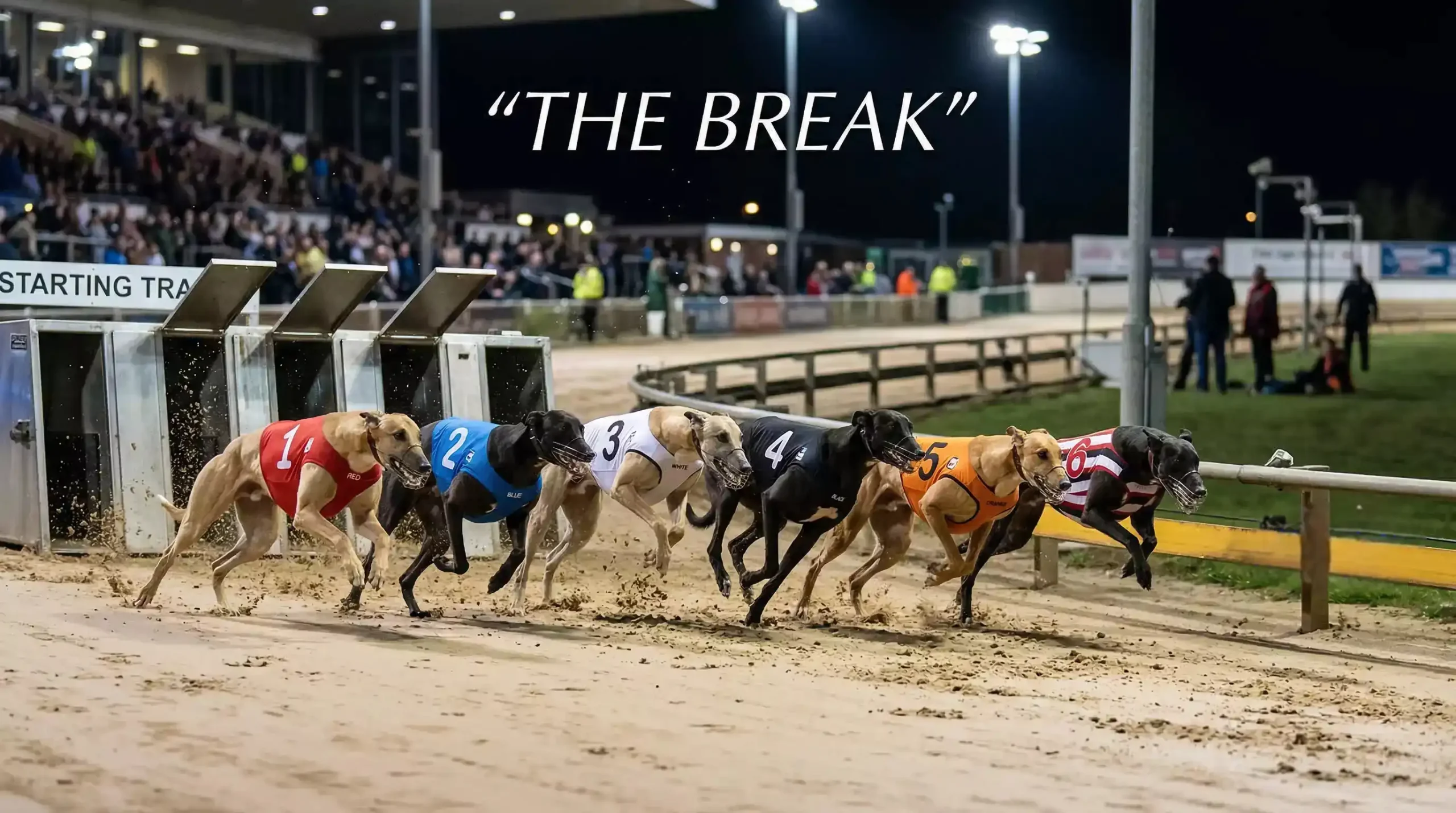
Before the race, each dog is paraded in front of the spectators wearing a coloured jacket that corresponds to its trap number. The colours are standardised across all UK tracks: Trap 1 is red, Trap 2 blue, Trap 3 white, Trap 4 black, Trap 5 orange, and Trap 6 black and white stripes. These colours allow spectators and television viewers to identify each dog instantly during the race. The parade also serves a practical purpose — it lets the racing manager confirm that all runners are fit and ready.
The dogs are then loaded into the starting traps, a mechanical gate system with six individual compartments. Each dog enters the box corresponding to its trap number. Once all six are loaded, the mechanical hare — an artificial lure mounted on a rail — begins its run along the outside of the track. As the hare passes the traps, the lids spring open and the dogs break out in pursuit.
What happens next depends on the distance. A 305m sprint covers two bends and is over in under 18 seconds — pure acceleration and early speed, with the dog that breaks fastest from the traps often holding on to win. A 500m race covers four bends and takes around 29 to 30 seconds, introducing tactical elements: the first bend determines early positioning, the back straight allows faster dogs to make up ground, and the final straight rewards dogs with stamina and a strong finish. Longer distances — 680m, 700m, and beyond — add more bends and more tactical complexity, with stamina becoming the dominant factor.
At the finish, the first dog to cross the line wins. Photo finishes are used when margins are too close to call with the naked eye, and official times are recorded electronically to hundredths of a second. Each dog’s finishing position, time, and running comment are then compiled into the official result, which feeds into the form database that punters use to analyse future races.
A typical meeting features twelve to fourteen races, with approximately fifteen minutes between each. An evening card at a venue like Nottingham starts around 18:00 and finishes around 21:45 — roughly three and a half hours of racing, which makes it one of the more compact sporting evenings you can attend.
How to Start Following Greyhound Racing in the UK
The easiest way to start following greyhound racing is to watch it. The Greyhound Racing UK platform, launched in March 2025 as part of the sport’s centenary celebrations, has already attracted over 10 million digital views and offers race replays, results, and editorial content. It’s free to access and designed to serve both newcomers and established followers. Beyond the official platform, most major bookmakers stream live greyhound racing through their websites and apps — Ladbrokes, Coral, William Hill, Paddy Power, and Betfred all carry meetings from Premier Greyhound Racing stadiums.
If you’d rather experience the sport in person, pick a local track and go on a regular meeting night rather than a feature event. The crowds are smaller, the atmosphere is more relaxed, and you’ll have more space to observe and learn without the pressure of a big occasion. Buy a racecard at the door, find a spot in the grandstand, and watch the first two or three races without betting. Pay attention to how the dogs break from the traps, how the field shapes up at the first bend, and which dogs finish strongest. Once the mechanics of a race start making sense visually, the racecard data — trap draws, form figures, times — becomes much easier to interpret.
When you’re ready to bet, start with win bets at small stakes. A £2 win bet on a dog you’ve studied is more educational than a £20 accumulator you’ve thrown together on instinct. Learn to read the form abbreviations on the racecard — QAw (quick away), EP (early pace), Crd (crowded), RnUp (ran up) — because they describe how each dog races, not just how fast it runs. Over time, you’ll start recognising patterns: dogs that always lead, dogs that always finish strongly, dogs that consistently get into trouble at the first bend.
Greyhound racing rewards patience more than most sports. The learning curve is gentle, the meetings are frequent, and the data is more accessible now than it has ever been. Whether you end up as a casual spectator who visits once a month or a dedicated form student who analyses every card, the sport has room for both — and the six-dog field format means you’re never far from understanding what’s happening.
The wider context is set out in our Nottingham dog results guide.
