

Why the St Leger Moving to Nottingham Changes the Track’s Profile
The St Leger at Nottingham is the newest addition to Colwick Park’s Category 1 programme — and the one that most dramatically alters the stadium’s competitive identity. When the St Leger moved to Nottingham in 2025, it brought a stayers’ classic to a venue previously defined by its 500m standard-distance programme. The addition means Nottingham now hosts five Category 1-level events across the year, a concentration of prestige that places it among the top two or three stadiums in the UK for flagship greyhound racing.
The St Leger is not just another competition in the calendar. It’s a race with its own lineage, its own audience, and its own demands — demands that test a different kind of greyhound from the ones that contest the Select Stakes or the Eclipse. Understanding why the St Leger matters, how it arrived at Colwick Park, and what to expect from the race is the subject of this guide.
The St Leger’s Journey: From Wembley to Wimbledon to Colwick Park
The Greyhound St Leger is one of the oldest named competitions in British dog racing, with a history that traces back through multiple venues and decades of stayer competition. Like many of the sport’s landmark events, it has been a nomad — displaced by stadium closures and reshuffled between venues as the UK track network contracted.
Wembley hosted the St Leger during the sport’s golden age, when the stadium’s vast crowds and national profile lent the event a glamour that matched the English Greyhound Derby. When Wembley’s greyhound operation ended, the St Leger moved to Wimbledon, which became the spiritual home of classic greyhound competition in London. Wimbledon’s own closure in 2017 displaced the St Leger again, sending it on a journey through several temporary homes before it found its way to Nottingham.
The move to Colwick Park was announced in 2024 and coincided with what David Evans, General Manager of Nottingham Stadium, described as a bumper year at the stadium, with four new Category One champions crowned. The St Leger’s arrival extended that momentum into 2025, giving Nottingham a stayer event that complemented its existing portfolio of standard-distance and sprint competitions. Within the broader context of British greyhound racing — where the total annual prize fund across all tracks stands at £15.7 million — the St Leger’s prize purse positions it as a significant event, though not on the scale of the English Greyhound Derby’s £175,000.
For the sport’s organisers, placing the St Leger at Nottingham was a deliberate strategic choice. The stadium had proven its ability to host top-level competition during the 2019 and 2020 Derby residencies. The PGR media rights deal ensured full broadcast coverage. And the distance range at Colwick Park — extending to 925m on the marathon distances — meant the track could accommodate the St Leger’s stayer format without modification. The pieces fitted, and the decision was made.
Race Format: Distance, Rounds and Qualification
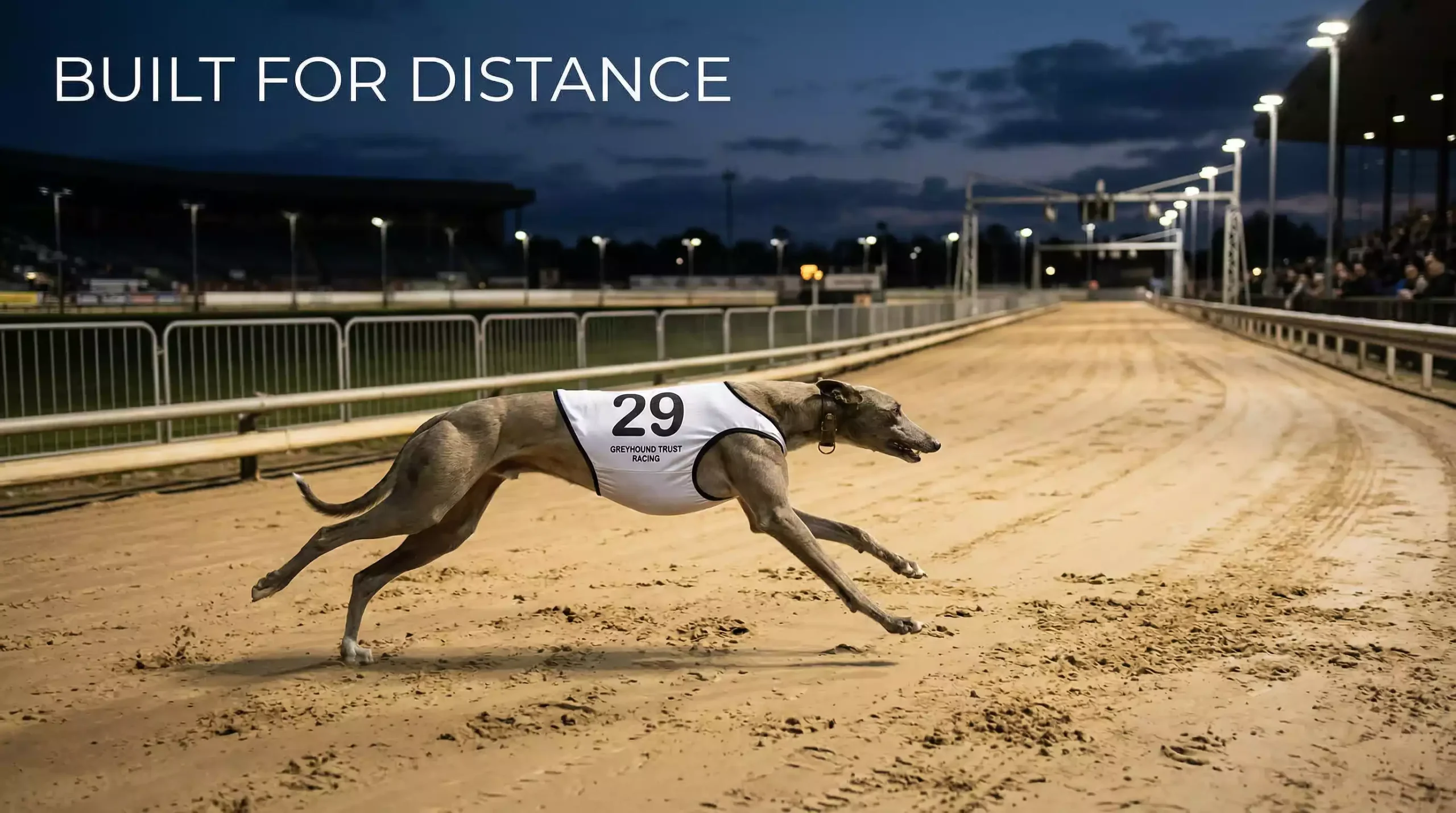
The St Leger is contested over a staying distance — typically 700 metres or above at Nottingham, which places it firmly in the territory where stamina, pace judgement, and the ability to handle multiple bends become more important than raw trap speed. The race uses a multi-round format: heats, semi-finals, and a final, spread across two or three weeks. This tournament structure tests consistency as much as ability, because a dog that wins its heat must recover and reproduce that performance in the semi-final and then again in the final.
Qualification is typically by invitation, with the strongest staying greyhounds in the country nominated by their trainers. The field is assembled based on recent form over staying distances, with an emphasis on calculated times, finishing positions in similar events, and the professional reputation of the entries. The invitation process ensures that every dog in the St Leger is a proven stayer rather than a standard-distance runner taking a speculative step up.
The staying distance changes the analytical framework for punters. Over 700m and above, the race involves six or more bends, which amplifies the advantage of dogs that run the rail — academic research has confirmed that rail runners cover the shortest distance, a saving that compounds with every additional turn. Early pace is less decisive than on the 500m because the race is long enough for mid-race movers and closers to make up ground. What matters more is sustained speed: the ability to maintain pace from the third bend to the sixth without fading. Dogs that show strong final splits in their sectional times over standard distances are natural candidates for staying success, because the quality they display in the last hundred metres of a 500m race is the quality they’ll need for the last three hundred metres of a 700m trip.
Attending or Watching the St Leger at Nottingham
The St Leger operates within Nottingham’s regular evening meeting schedule, with the feature race integrated into a full card of graded and open races. The first race goes off around 18:00–18:37 on event nights, and the St Leger heat or final is positioned as the headline event — usually around the middle of the card, giving the crowd time to settle in and the atmosphere to build.
For those attending in person, the experience mirrors other Category 1 nights at Colwick Park but with a distinct flavour. Stayer races are visually different from sprints and standard-distance events: the dogs pass the grandstand twice on a 700m trip, and the longer race duration allows spectators to follow the tactical development in a way that the eighteen-second sprint doesn’t permit. The atmosphere is more anticipatory, the commentary more narrative, and the crowd reactions more sustained — there’s time to cheer, to worry, and to calculate your position before the dogs hit the final straight.
For punters watching online, the St Leger is broadcast through the full PGR network — Ladbrokes, Coral, William Hill, Paddy Power, and Betfred all carry the stream. Markets for the heats and final open earlier in the day than standard graded races, reflecting the event’s higher profile and the heavier betting volume it generates. The semi-final and final stages attract particularly active markets, and the on-course bookmakers on site at Colwick Park offer competitive odds to match the volume.
Whether the St Leger establishes a permanent home at Nottingham or eventually moves again depends on factors beyond the sport’s control — commercial agreements, stadium economics, and the broader regulatory environment all play a role. But for now, the stayers’ classic sits at Colwick Park, and Nottingham’s programme is richer for its presence. The St Leger gives the venue a fifth Category 1-level fixture, a stayer dimension that none of its other headline events provide, and a connection to a tradition that stretches back through the golden age of greyhound racing. For a stadium that first opened its traps in 1980, hosting one of the sport’s oldest classic events is an achievement that speaks to both commercial competence and competitive ambition.
The wider context is set out in our Nottingham dog results guide.
