
When the Derby Came to Nottingham: A Two-Year Chapter
The Greyhound Derby at Nottingham was a two-year interlude that elevated Colwick Park from a respected regional venue to a stadium capable of staging the biggest event in British greyhound racing. The English Greyhound Derby — the sport’s blue riband, carrying first-place prize money of £175,000 — arrived at Nottingham in 2019 after Towcester’s temporary unavailability forced a venue change, and it returned in 2020 under circumstances nobody had predicted.
Those two years compressed more drama, prestige, and controversy into Nottingham’s history than the previous four decades of regular racing had produced. The 2019 edition brought the sport’s spotlight to the East Midlands for the first time. The 2020 edition unfolded in the surreal conditions of a global pandemic. Together, they changed how the stadium — and the wider industry — thought about what Colwick Park could accommodate.
The 2019 Derby: Nottingham’s First Hosting
The 2019 English Greyhound Derby was the first time the competition had been held at Nottingham. The event’s journey to Colwick Park was itself a story of displacement: the Derby had previously been held at Wimbledon, then at Towcester following Wimbledon’s closure, and the move to Nottingham came when Towcester experienced operational difficulties. For the sport’s organisers, finding a venue capable of staging the Derby at relatively short notice was a logistical challenge. For Nottingham, it was an opportunity that might not come again.
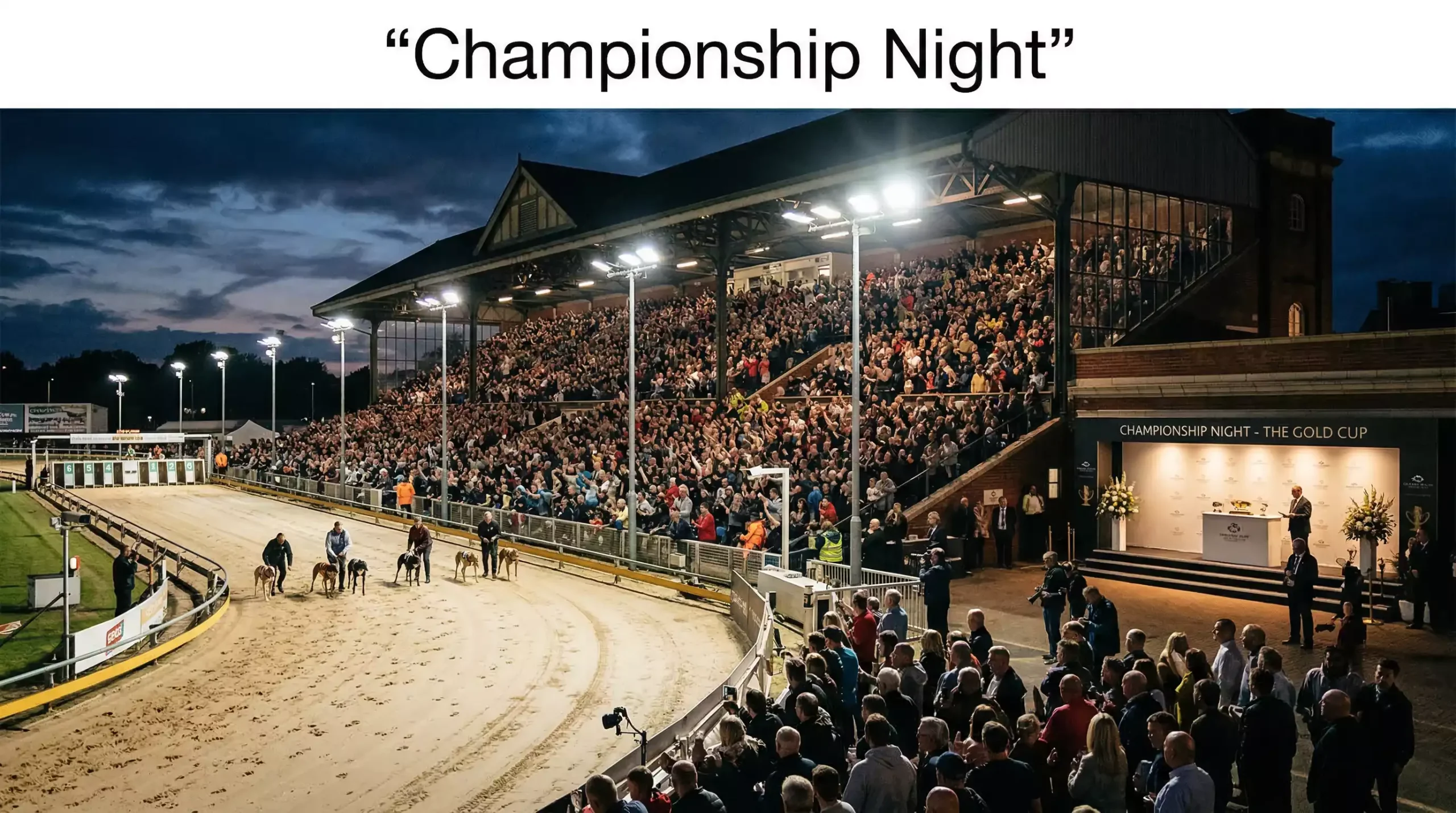
The stadium rose to the occasion. The 500m standard distance — the format used for the Derby — was one Nottingham knew intimately, and the track’s facilities, while more compact than some previous Derby venues, proved adequate for the scale of the event. The card attracted entries from across the country, with the best trainers sending their strongest dogs to compete for the biggest prize in the sport. The opening night of the competition drew a full house, with the stadium’s 1,500-person capacity stretched by the influx of visitors who wouldn’t normally attend a Nottingham meeting.
The 2019 Derby also coincided with a period of heightened scrutiny around greyhound welfare. Animal welfare organisations used the event’s media profile to amplify their criticisms of the sport, and the GBGB found itself defending the industry on a national stage. Jeremy Cooper, then Chair of the GBGB and a former CEO of the RSPCA, pushed back forcefully against what he characterised as ill-conceived tactics by pressure groups attempting to galvanise support at the extreme end of the animal rights movement, arguing that the focus should be on the sport’s improving welfare record rather than on ideological opposition to racing itself.
On the track, the 2019 Derby produced compelling racing. The competition format — heats, semi-finals, and a six-dog final — generated a week of betting activity and media coverage that Nottingham had never previously experienced. The final itself was a tight affair decided by a small margin, confirming that the quality of racing at Colwick Park was genuine and that the dogs had performed to the standard expected of a Derby venue.
2020: A Derby Behind Closed Doors
If the 2019 Derby at Nottingham was defined by its sense of occasion, the 2020 edition was defined by its absence. The COVID-19 pandemic forced the event behind closed doors — no spectators, no trackside atmosphere, no packed grandstand. The dogs raced in front of empty terraces and camera operators, and the public followed the competition through television and online streams rather than through the turnstiles.
Running a Derby behind closed doors was an organisational achievement that required Nottingham to adapt quickly. The stadium had to implement biosecurity protocols for trainers and staff, arrange socially distanced kennelling, and manage a competition timeline that was subject to potential disruption at any point if a COVID case emerged within the racing bubble. That the event ran to completion, on schedule, without a significant outbreak was a testament to the planning and discipline of the Colwick Park operation.
The racing itself was arguably purer for the absence of the crowd. Without the roar of spectators, the sound of the traps opening, the hare motor, and the dogs’ footfall on the sand were all audible through the broadcast microphones — a stripped-back sonic experience that highlighted the raw mechanics of greyhound racing. Some television viewers found it eerie; others found it compelling in a way that the usual cacophony of a full-house meeting didn’t allow.
The 2020 Derby final produced a worthy winner, though the event lacked the celebratory atmosphere that normally surrounds the blue riband. There were no post-race interviews on a packed podium, no champagne sprayed in front of thousands of fans. The winner’s connections collected their prize in circumstances that felt more administrative than triumphant. It was a Derby that happened rather than a Derby that was experienced — and that distinction coloured how the event is remembered within the sport. For Nottingham, though, the achievement stood regardless: the stadium had successfully delivered the most complex sporting event of 2020 at a time when many larger venues couldn’t operate at all.
What the Derby Left Behind at Colwick Park
The Derby moved away from Nottingham after 2020, with the event subsequently finding a more permanent home at Towcester. But the two-year residency left a lasting imprint on Colwick Park’s identity and capabilities.
Operationally, Nottingham proved that it could stage the sport’s largest event. The stadium infrastructure — track surface, lighting, broadcast facilities, parking, hospitality — met the standard required for a £175,000 competition. That proof of concept directly influenced the decisions that followed: the acquisition by Arena Racing Company in 2020, the integration into the PGR network, and the allocation of four Category 1 events to the Nottingham calendar. None of these developments were guaranteed, but the Derby years demonstrated that the venue had the capacity and the organisational competence to handle top-level competition.
The most tangible legacy is the St Leger, which moved to Nottingham in 2025. The St Leger is one of the classic stayer events in the greyhound calendar, and its arrival at Colwick Park can be read as a direct consequence of the Derby years — the sport’s governing bodies and commercial partners had seen Nottingham operate at the highest level, and they trusted the venue to host another flagship competition. The St Leger doesn’t carry the Derby’s £175,000 prize, but it carries the prestige of a Category 1 classic, and its presence cements Nottingham’s status as one of the premier greyhound racing venues in the UK.
For punters who follow Nottingham, the Derby legacy means a track that has been tested at the highest competitive standard and found capable. The dogs may not be Derby quality on a routine Monday night, but the track, the timing equipment, the broadcast operation, and the racing management are all calibrated to an event-hosting standard that few UK greyhound stadiums can match. That operational quality filters down into the regular programme: accurate timing, consistent track maintenance, professional racecard data, and a broadcast feed that serves form analysis as well as entertainment. The two years that the Derby spent at Colwick Park shaped the venue into something more than it was before — and the effects of that transformation persist long after the blue riband has moved on.
The wider context is set out in our Nottingham dog results guide.
