
Forty-Six Years of Greyhound Racing at Colwick Park
Nottingham greyhound stadium history begins on a cold Thursday evening in January 1980, when more than 2,000 spectators crowded into the new Colwick Park venue to witness its inaugural meeting. The first winner was a dog named Tartan Al, trained by W Horton, who clocked 32.98 seconds over 500 metres at starting odds of 7/1. It was an unremarkable time for a debut race, but it marked the beginning of a stadium that would grow to become one of the most significant greyhound venues in central England.
What followed across the next four and a half decades is a story of survival, reinvention, and periodic glory — a trajectory that mirrors the broader arc of British greyhound racing itself. The sport that once filled 77 licensed tracks across the UK now operates from just 18 GBGB-licensed stadiums. Nottingham is among the survivors, and the fact that it’s still staging Category 1 events, hosting the English Greyhound Derby, and attracting investment in 2026 says something about the resilience of Colwick Park’s operation.
This is the full chronicle: from opening night to the present day.
1980–1999: Opening Night, Ballyregan Bob and the Rise
Nottingham’s opening in 1980 came during a period of contraction for British greyhound racing. The post-war golden age — when the sport drew millions of spectators annually and the stadium count peaked at 77 licensed tracks alongside more than 200 independent venues — had long since passed. By the late 1970s, the industry was consolidating, and new stadium openings were rare. Colwick Park was an exception: a purpose-built track designed to modern specifications, positioned within the Colwick Park leisure complex adjacent to Nottingham Racecourse.
The stadium’s early years were shaped by the quality of dogs that passed through it. Ballyregan Bob, one of the most celebrated greyhounds in British racing history, raced during this era, and while his record-breaking winning streak was set primarily at Brighton and Hove, his fame raised the profile of the sport nationally and drew attention to tracks like Nottingham that were establishing themselves as serious venues. The 1980s were a decade of competent operation at Colwick Park — regular fixtures, growing attendance, and a schedule that built the stadium’s reputation among trainers in the Midlands and beyond.
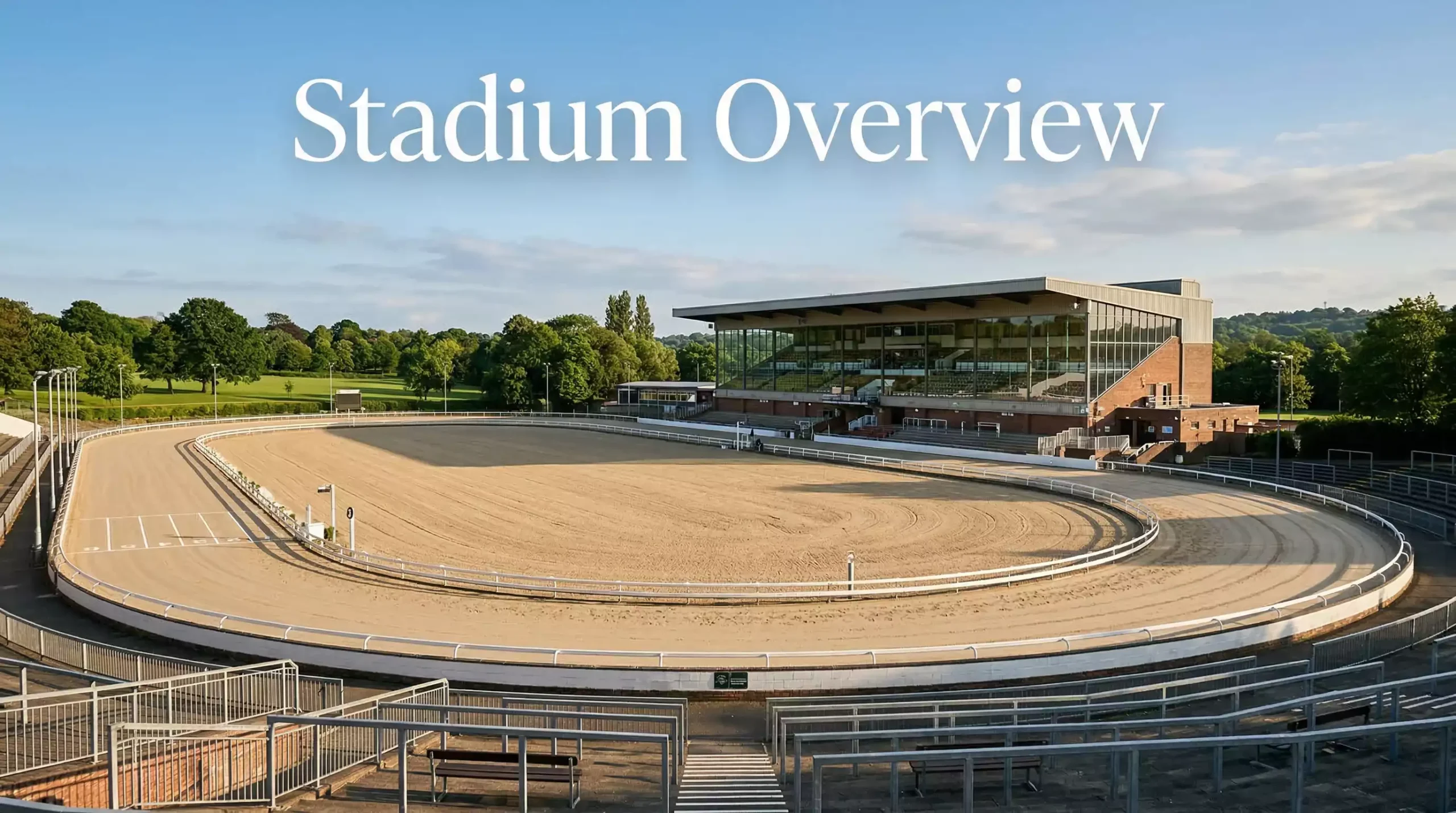
Through the 1990s, Nottingham consolidated its position. The track developed its programme of Open races, attracting higher-graded dogs from outside the immediate region. The stadium’s 437-metre circumference and sand surface proved popular with trainers, who appreciated the consistent racing conditions and the variety of distances available. By the end of the decade, Nottingham was firmly established in the middle tier of British greyhound tracks — not yet hosting the sport’s most prestigious events, but running a reliable and competitive programme that served both punters and the local racing community.
What distinguished this period was the stability. While other tracks opened and closed around it — victims of rising land values, declining attendances, and changing leisure habits — Colwick Park kept running. It wasn’t glamorous, and it wasn’t making headlines, but it was building the operational foundation that would later allow it to step up to a higher level.
2000–2020: The Derby Years and New Ownership
The 2000s brought the first real elevation of Nottingham’s status. The steady closure of other Midlands tracks — a process accelerated by the value of stadium sites for property development — left Colwick Park as the dominant venue in the region. Fewer tracks meant more dogs needed homes, and Nottingham’s kennel contacts expanded accordingly. The quality of fields improved, and with it, the quality of the racing.
The defining moment of this era came when Nottingham was selected to host the English Greyhound Derby in 2019 and 2020. The Derby is the blue riband of British greyhound racing, carrying first-place prize money of £175,000, and its arrival at Colwick Park was a statement of the stadium’s standing. The 2019 edition was the first Derby held at Nottingham, bringing national media coverage and a level of prestige that years of solid operation had earned. The 2020 Derby, held during the COVID-19 pandemic, ran behind closed doors — a surreal experience for a sport built on crowd atmosphere, but a logistical achievement that demonstrated the stadium’s organisational capability under extreme circumstances.
In 2018, the stadium signed a racing partnership with Arena Racing Company (ARC), one of the UK’s largest racecourse and stadium operators, to stage every Monday and Friday evening card. Two years later, in 2020, ARC completed the full acquisition, purchasing the stadium from Nottingham Greyhound Stadium Ltd. The takeover brought Nottingham into a portfolio that included horse racing venues and other greyhound tracks, giving it access to broader media distribution, corporate sponsorship networks, and operational expertise. It was a signal that institutional investors still saw value in greyhound racing — or at least in the venues that hosted it — at a time when the sport’s critics were growing louder.
The ARC ownership era also coincided with broader industry shifts. Regulatory pressure was increasing, welfare scrutiny was intensifying, and the number of active tracks continued to shrink. Nottingham’s position within the ARC portfolio insulated it from the worst of these pressures, but it also tied the stadium’s future to corporate decisions made at a level above the local management team.
2024–Present: Premier Greyhound Racing and St Leger
The most transformative development in Nottingham’s recent history is the launch of Premier Greyhound Racing in January 2024. PGR is a joint venture between Entain — the gambling conglomerate behind Ladbrokes, Coral, and other major brands — and Arena Racing Company. The deal, first announced in 2021 and running through to 2029, granted PGR exclusive media rights for twelve UK greyhound stadiums, including Nottingham. The commercial impact was immediate: distribution through every major retail bookmaker, increased prize money funded by media rights revenue, and a level of broadcast professionalism that the sport had previously lacked.
Under the PGR umbrella, Nottingham’s prize money reached new heights. The joint venture has invested more than £2.5 million into Open Race prize funds across its stadiums, and Nottingham’s share of that investment is visible in the record-breaking Select Stakes prize of £12,500 in 2024 and matching purses for the Puppy Classic. These aren’t transformative sums by the standards of horse racing, but in the context of greyhound competition — where a typical graded race might carry a winner’s prize of a few hundred pounds — they represent a meaningful step up.
The most significant fixture addition of this era is the St Leger, which moved to Nottingham in 2025. One of the classic stayer races in the greyhound calendar, the St Leger’s arrival at Colwick Park completed a suite of Category 1 events that now gives Nottingham four flagship competitions per year. For a track that opened in 1980 as a regional venue, hosting the St Leger alongside the Select Stakes, Eclipse, and Puppy Classic is a level of prestige that would have seemed improbable during those first two decades of operation.
The PGR era has also brought challenges. The concentration of media rights in a single joint venture means that Nottingham’s broadcast exposure is tied to corporate negotiations rather than open competition between broadcasters. And the broader industry faces headwinds: Wales is moving towards a ban on greyhound racing, Scotland is debating similar legislation, and three UK stadiums closed in 2025 alone. Nottingham’s position within the PGR structure provides a degree of commercial security, but the sport’s long-term trajectory remains uncertain. What is certain is that Colwick Park, 46 years after Tartan Al crossed the line first, is still racing — and racing at a higher level than ever before.
The wider context is set out in our Nottingham dog results guide.
The Derby came here twice: the Derby years.
