

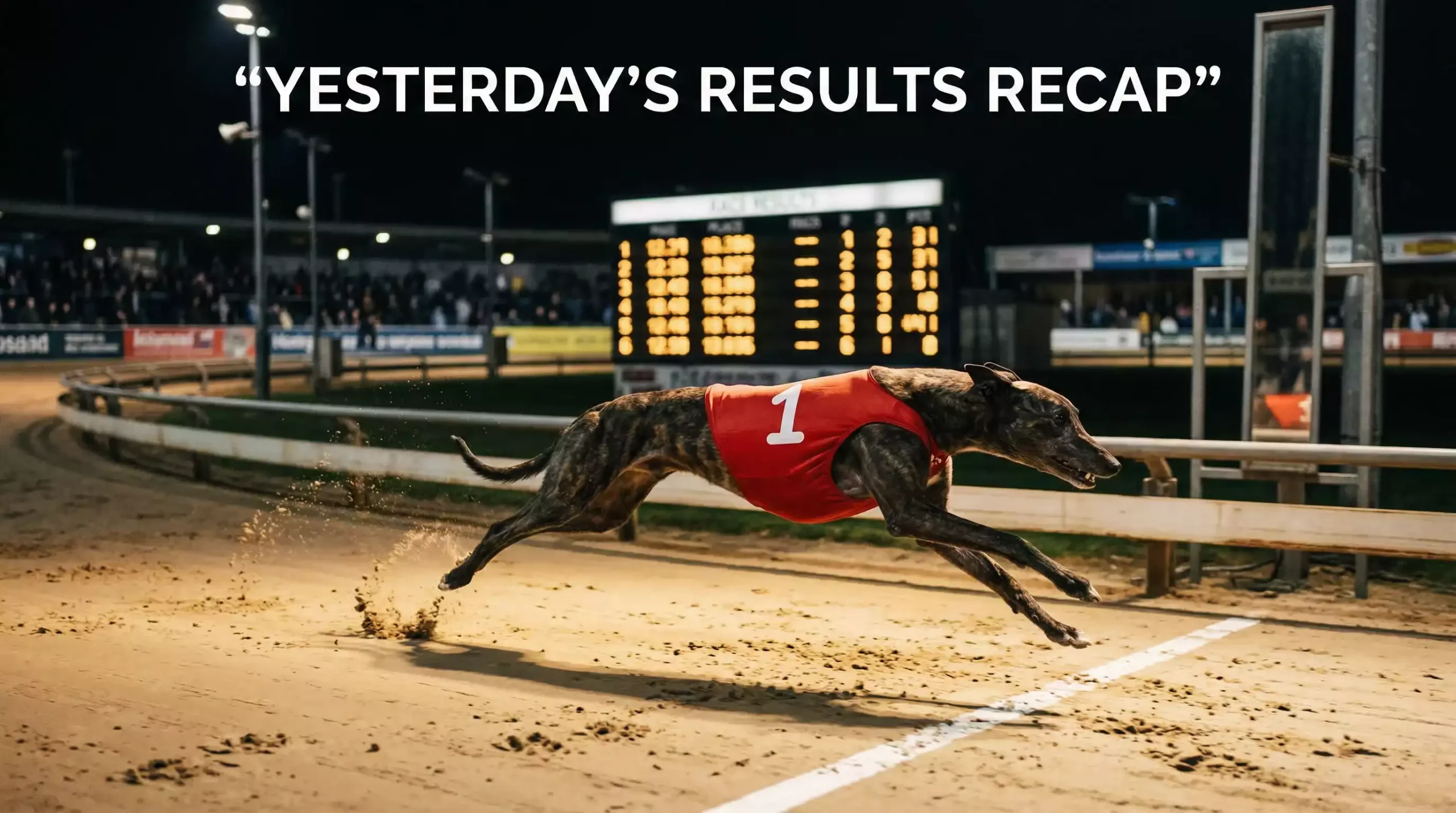
Where to Check Last Night’s Nottingham Greyhound Results
Nottingham greyhound results yesterday are the first thing thousands of punters look for the morning after a meeting at Colwick Park. Whether it was a Monday evening card, a Friday night session under floodlights, or one of the midweek morning BAGS fixtures, the data from the previous night’s racing tells a story that extends well beyond simple finishing positions. Times, trap draws, starting prices, and running comments all feed into the next card’s analysis. The question isn’t whether you should check yesterday’s results — it’s how quickly you can get to them and what you do with them once they’re in front of you.
Nottingham operates a regular weekly schedule: Monday and Friday evenings, plus Wednesday and Thursday morning meetings. That rhythm means there’s fresh data to process almost every day of the week. And if you’re betting on today’s card, yesterday’s results aren’t background reading — they’re your primary research material.
The good news is that the days of waiting for newspaper columns or phoning the stadium are long gone. Multiple platforms publish Nottingham results within minutes of the final race, and the depth of data available — from sectional times to forecast dividends — has never been greater. The challenge is knowing where to look and, more importantly, knowing what to look for.
What Yesterday’s Results Tell You About Today’s Card
Yesterday’s results at Nottingham don’t just tell you who won — they tell you how the track is running, which trainers are in form, and where the value might sit on the next card. The trick is reading between the lines rather than fixating on winners and losers.
Start with the times. If last night’s 500m races were consistently coming in two or three spots slower than the calculated time, the going was heavy. That’s not a footnote — it’s a selection filter. Dogs who handle heavy sand will hold an edge again if conditions haven’t changed, and at Nottingham, sand track conditions can persist across consecutive meetings. Compare the going allowance printed in the racecard against the actual finishing times from yesterday, and you’ll quickly see whether today’s card demands a recalibration of your speed figures.
Then there’s trap performance. Across UK greyhound racing, favourites win roughly 30% of the time, which means seven out of ten races produce an upset relative to market expectation. Yesterday’s results can reveal whether the track is playing true to its usual trap bias or whether outside runners had a better night than expected. If Trap 6 dogs were consistently finishing in the frame during last night’s sprints, that’s a data point worth carrying into your analysis of today’s 305m races.
Running comments from the previous card are equally important. A dog described as “crowded at the second bend” yesterday might have been the best animal in the race but hit trouble. Check whether that dog reappears on today’s card — and whether the draw gives it a cleaner run this time. Form abbreviations like Crd (crowded), Bmp (bumped), and Ck (checked) are not just descriptions. They’re flags that signal unrealised potential.
Weight changes between meetings can also surface in yesterday’s data. A greyhound that raced two pounds heavier than its previous outing may have been carrying condition — or it may have peaked. Track the weight column alongside the time column, and patterns emerge over two or three meetings that a single result wouldn’t reveal.
Finally, pay attention to the starting prices. A dog that opened at 5/1 in the morning but drifted to 8/1 by race time was subject to market correction — the money moved away. If that dog then ran a creditable second, beaten half a length, the SP tells you the public lost faith but the form says otherwise. That disconnect is where value lives on the next card.
Best Sources for Nottingham Archive Results
Not all results platforms are created equal, and the source you use shapes the depth of your analysis. Here’s where to find Nottingham’s archived results, ranked by the quality of data they provide.
The Nottingham Greyhound Stadium official website publishes results from each meeting, typically within an hour of the final race. You’ll find trap, finishing position, time, starting price, and basic running comments. It’s clean, official, and reliable — but it won’t give you sectional splits or historical form lines.
For deeper data, the Greyhound Racing UK platform — launched in March 2025 as part of the sport’s centenary celebrations — has quickly become a go-to resource, attracting over 10 million digital views in its first months of operation. The platform provides race replays alongside result data, which lets you watch a dog’s run rather than relying solely on the comment line. Seeing a dog get checked at the third bend carries different weight than reading “Ck3” in a form guide.
Timeform and the Racing Post’s greyhound section both offer form databases that store Nottingham results alongside historical performance data. These are particularly useful for comparing yesterday’s times against a dog’s career form. If a dog ran 29.50 over 500m last night but its best is 28.90, you know it’s either coming back from a break or struggling with the conditions. Context matters, and these databases provide it.
Attheraces.com carries results for all meetings televised through Sky Sports Racing and the SIS feed. Their archive extends back several years, making it a solid option for spotting longer-term patterns — whether a particular dog consistently improves at Nottingham, or whether a trainer’s string performs better on certain days of the week.
For punters who prefer raw data, some third-party sites aggregate results across all UK tracks and allow filtering by trap, distance, or trainer. The specifics of each site change, but the principle remains: yesterday’s results are the foundation of today’s edge, and the more granular your source, the sharper that edge becomes.
Monday vs Friday vs Morning: How Results Differ by Session
Nottingham’s weekly schedule creates distinct racing environments, and yesterday’s results carry different implications depending on which session produced them. The source you use matters, but so does the context of the meeting itself.
Monday and Friday evening meetings are the flagship sessions. These cards tend to feature higher-graded races, stronger fields, and tighter finishing margins. If yesterday was a Friday night, the results reflect a competitive meeting where form held up more reliably. Times from these evenings are useful benchmarks for future analysis because the quality of opposition provides a genuine test. A dog that wins an A2 graded race on Friday night at Nottingham has beaten a field that means something.
Wednesday and Thursday mornings are a different proposition entirely. These BAGS meetings — Bookmakers’ Afternoon Greyhound Service, despite the name now covering mornings too — exist primarily to service the betting shop schedule. The fields often include dogs from lower grades, those returning from injury, or runners that trainers are giving an outing to maintain fitness. Times from morning meetings are less reliable as performance indicators because the competitive intensity is lower. A dog clocking 29.20 on a Thursday morning might run 29.60 on a Friday night against stronger opposition, or might improve to 28.90 when pushed by better rivals.
This session distinction matters when you’re using yesterday’s results to inform today’s bets. If a dog won comfortably in a Wednesday morning race and now appears on Friday’s card against a step up in grade, the morning form needs to be discounted accordingly. Conversely, a dog that finished a close third on Monday night may be dropping into a weaker Thursday race — and yesterday’s result might understate its chances.
Track conditions add another layer. Evening meetings in winter can be affected by falling temperatures during the card, meaning the last few races of a Monday night often produce slower times than the opener. Morning meetings in summer may run on a track that’s drying out between races, producing progressively faster times as the card develops. These environmental factors are invisible in a simple results table but become apparent when you compare finishing times across the card from yesterday’s meeting.
The wider context is set out in our Nottingham dog results guide.
