

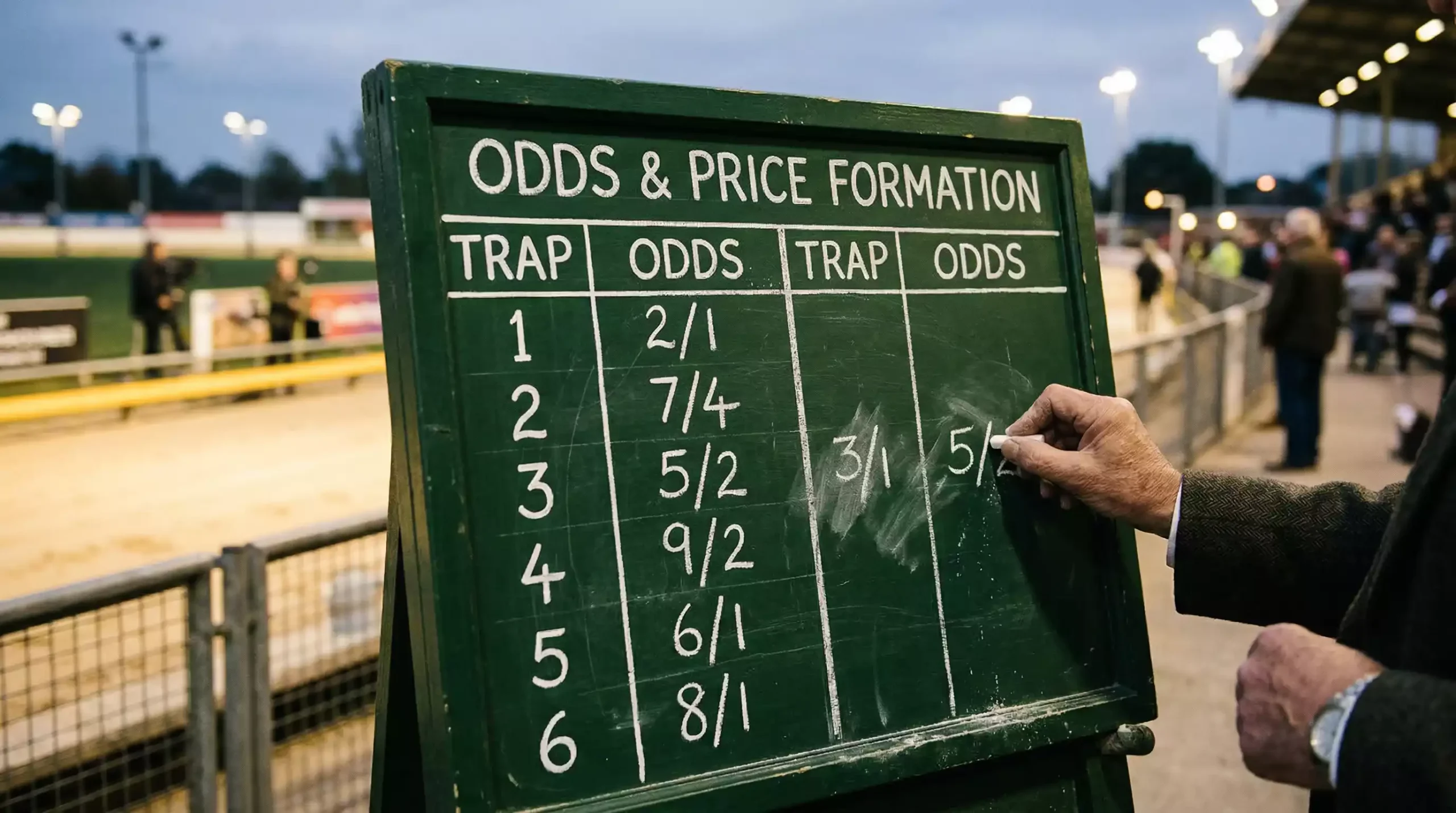
How Nottingham Greyhound Odds Work From First Show to SP
Nottingham greyhound odds are not random numbers plucked from thin air. They’re the product of a process that begins hours before the first trap opens and continues right up to the moment the hare passes the boxes. Understanding that process — how odds form, why they move, and what the different pricing mechanisms mean — is the difference between placing bets and placing informed bets.
Greyhound betting generates substantial turnover across the UK. The most recent Gambling Commission data puts the annual betting turnover on dogs at approximately £794 million, a figure that reflects the sport’s enduring presence in Britain’s betting culture. A meaningful slice of that turnover flows through Nottingham’s Monday and Friday evening cards, where competitive fields and regular scheduling attract consistent market activity.
This article breaks down the lifecycle of a greyhound price at Nottingham — from the initial tissue prices set by bookmaker traders to the final starting price returned after the off. Along the way, it covers the mechanisms that can work in your favour: Best Odds Guaranteed, Tote pool betting, and Betfair Starting Price. If you’re betting on Nottingham dogs without understanding these tools, you’re leaving money on the table.
From Tissue Prices to Starting Price: The Lifecycle of Odds
The first set of odds for a Nottingham race — known as the tissue — is compiled by bookmaker traders several hours before the meeting. Tissue prices are essentially the trader’s opening assessment of each dog’s chance, based on recent form, grade, trap draw, and track conditions. They’re not published to the public as a formal market, but they form the basis of the early prices that appear on bookmaker websites once the market opens.
Early prices, sometimes called “board prices” or “morning prices,” typically appear four to six hours before the first race on evening cards. These are the first odds the public can bet into. At this stage, the market is thin — not much money has been wagered — so the prices reflect the bookmaker’s assessment more than the weight of public opinion. For sharp punters, early prices can be valuable because they occasionally overprice a dog that the market will later shorten on. Taking 5/1 in the morning about a dog that goes off at 3/1 is a significant edge, assuming your analysis supports the selection.
As the afternoon progresses and more bets are placed, prices adjust. Money for a particular dog causes its odds to shorten, while money moving away causes drift. This is the visible expression of the market’s collective judgement. By the time the dogs are in the parade ring, the prices have absorbed information from thousands of individual bets, stable whispers, and the occasional large wager from a confident punter. The on-course bookmakers — if you’re watching at Colwick Park — reflect this in real time, adjusting their boards between races.
The starting price (SP) is the final set of odds, returned at the moment the traps open. It’s determined by an independent assessor who surveys the on-course market and records the prevailing price for each runner. The SP matters because many bets — especially those placed in betting shops — are settled at SP rather than the price displayed when the bet was placed. If you took an early price and the dog shortened, you’ve secured better odds than SP. If you took early odds and the dog drifted, you’ve locked in a worse price than you would have got by waiting.
That tension — when to strike — is the core tactical decision in greyhound betting. There’s no universally correct answer. The right approach depends on whether you believe the market is underestimating or overestimating a dog’s chance at the point when you’re ready to bet.
Best Odds Guaranteed, Tote and BSP Explained
Best Odds Guaranteed is one of the most punter-friendly promotions in greyhound betting, and it’s offered by most major UK bookmakers for Nottingham meetings. The principle is simple: if you take an early price on a dog and the SP is higher, the bookmaker pays you at the better price. If the SP is lower, you keep the early price you took. Either way, you get the best of both worlds.
BOG eliminates the timing dilemma described above — at least partially. With BOG active, taking an early price carries no downside risk from a pricing perspective, because the bookmaker will match any SP improvement. The catch is that BOG terms vary between bookmakers. Some restrict it to certain meeting types, exclude specific bet types like forecasts, or cap the maximum payout. Always check the small print before assuming BOG is in play for tonight’s Nottingham card.
The Tote pool operates on a completely different principle. Instead of fixed odds, Tote bets go into a pool, and the final dividend is determined by the total pool size minus the operator’s deduction, divided among winning tickets. Tote dividends can be significantly higher or lower than SP, depending on how the pool money is distributed. On a Nottingham race where the public piles into one favourite, the Tote dividend on an outsider can be substantially larger than the fixed-odds return — because fewer punters in the pool have backed that dog.
The flipside is equally true. Favourites win around 30% of greyhound races across UK tracks, and when they do, the Tote dividend on the favourite is often disappointing compared to SP because so much pool money is concentrated on that runner. Tote betting rewards contrarian thinking. If your analysis tells you an outsider has a genuine chance — not just a prayer, but a form-backed argument — the Tote pool can amplify the reward.
Betfair Starting Price (BSP) is a third mechanism, derived from the Betfair Exchange market. BSP is calculated from matched bets on the exchange at the time the race starts. For greyhound racing, exchange liquidity is generally lower than for horse racing, which means BSP can sometimes produce outlier prices — both generous and stingy. It’s a useful reference point rather than a primary betting vehicle for most Nottingham punters, but it’s worth noting that some bookmakers now offer BSP as a settlement option on selected races.
How to Spot an Overlay in Nottingham Markets
An overlay exists when a dog’s odds are longer than its true chance of winning. Spotting one requires you to form your own assessment of the probability before comparing it to the market price — and that’s where most punters fall short. They look at the odds and try to find reasons to justify the price, rather than building an independent view first.
Start by estimating each dog’s chance as a rough percentage. In a six-runner field, the theoretical average is 16.7% per dog. A strong favourite might warrant 35–40%. A no-hoper might be worth 5%. Assign your percentages across the field, making sure they add up to approximately 100%. Then compare your figures against the implied probability of the bookmaker’s odds. If the bookmaker has a dog at 6/1 — implied probability 14.3% — but your analysis says the dog has a 22% chance, that’s an overlay. The price is longer than the dog’s actual merit warrants.
At Nottingham, overlays tend to appear in specific situations. Dogs stepping up in distance for the first time often drift in the market because the public prefers proven form over potential. A sprinter moving from 305m to 500m might be an unknown quantity in the market’s eyes, but if its sire line is associated with stamina and its sectional times suggest it finishes races strongly, the drift could be unwarranted. Similarly, dogs returning from a short break — two or three weeks off — sometimes drift because punters are wary of ring-rust. But trainers at Nottingham don’t rest dogs without reason, and a refreshed dog in a suitable grade can represent excellent value.
One more pattern worth watching: trap bias overlays. When a strong form dog draws an unfavoured middle trap at Nottingham, the market often pushes its price out. But if that dog has a clear early-pace advantage over every other runner in the race, the trap disadvantage is partly neutralised by its break speed. The market tends to overweight trap draw and underweight raw pace, and that misalignment creates overlays that careful form readers can exploit.
Finding value is not the same as finding winners. A dog can represent value at 4/1 and still lose. The discipline lies in consistently identifying and backing overlays over hundreds of races, trusting that the maths will compound in your favour across the long run. One evening’s results are noise. A season’s results are signal.
The wider context is set out in our Nottingham dog results guide.
Which bet to place is covered in greyhound bet types.
