

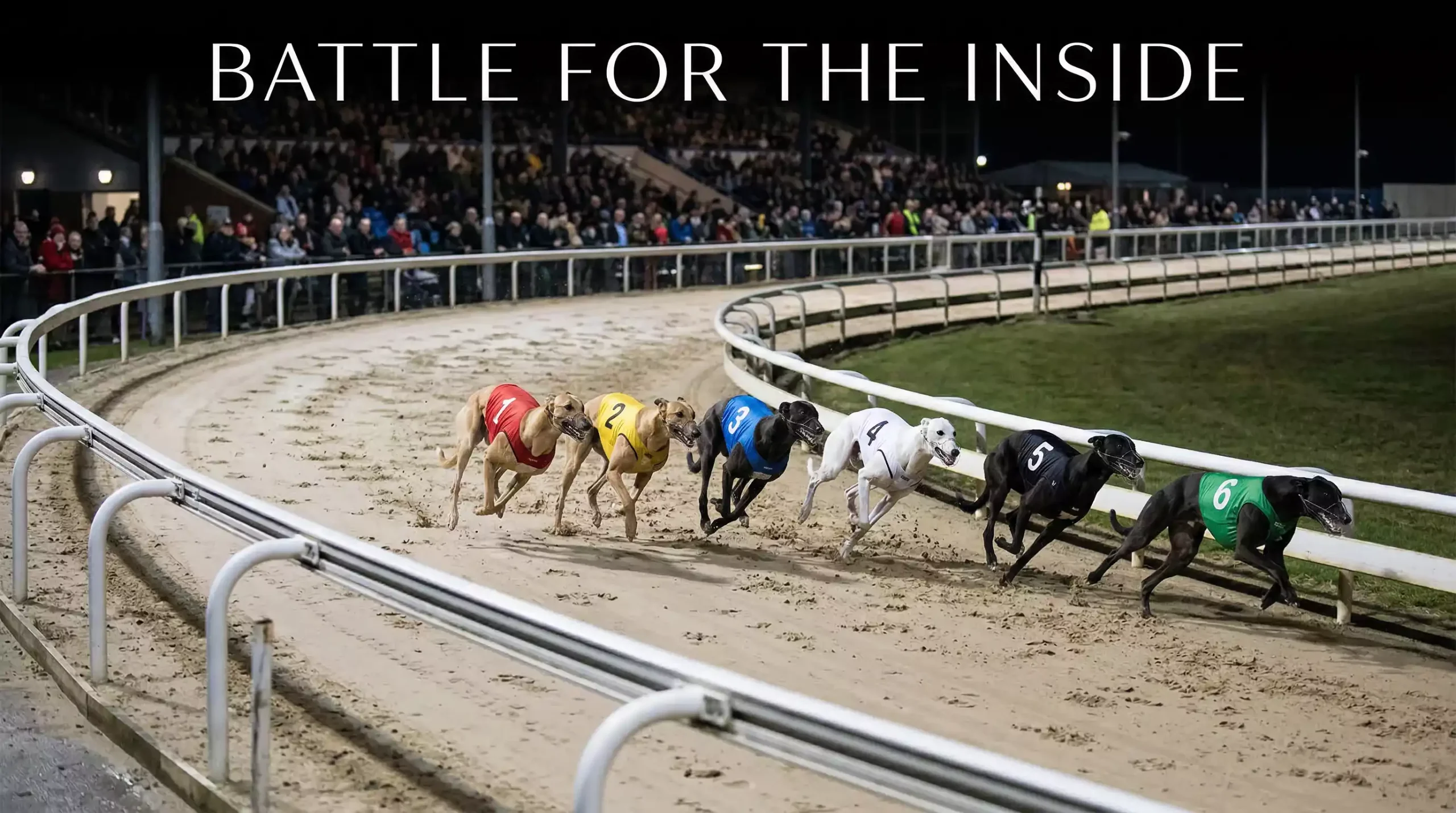
Why 500m Is Nottingham’s Defining Distance
Nottingham 500m results appear on more racecards than any other distance at Colwick Park. The 500-metre trip is the standard — the distance around which the grading system is calibrated, the benchmark against which dogs are assessed, and the race format that generates the largest share of betting turnover at the stadium. On a typical twelve-race evening card, six or seven races will be run over 500m, making it the distance that any serious Nottingham punter must understand in depth. It’s where the grading time bands are set, where trainers test their best prospects, and where the majority of form data originates.
The 500m at Nottingham covers four bends on a 437-metre circumference track, which means the dogs complete slightly more than one full lap. That geometry produces a specific racing character: the bends are tight enough to reward rail runners, the straights are long enough to allow positional changes, and the race lasts approximately 29 to 30 seconds — enough time for early speed, mid-race tactics, and a finishing effort to all play a role.
Benchmark Times and What They Mean for Grading
The history of the 500m at Nottingham is bookended by two significant times. When the stadium opened on 24 January 1980, the first winner — Tartan Al — clocked 32.98 seconds, a time that reflected both the era’s greyhound genetics and the brand-new track surface. The current record, held by Proper Heiress at 28.95, represents a four-second improvement that spans decades of selective breeding, surface technology, and training methods. That gap illustrates how far the sport has come at this venue.
For grading purposes, the 500m time bands at Nottingham define which dogs compete at which level. A rough guide: sub-29.50 calculated times place a dog in A1 or A2 territory; 29.50 to 30.00 spans A3 to A5; 30.00 to 30.80 covers A6 to A8; and anything above 30.80 sits in the lower grades. These bands shift slightly depending on the depth of the dog population at the track at any given time, but the principle is constant: the grading system uses 500m calculated times as its primary sorting mechanism.
Understanding where a dog’s times sit within the grading bands tells you two things. First, whether the dog is well-placed in its current grade or about to be promoted or demoted. A dog running 29.60 in an A4 race is operating at the top of its grade and likely to be moved up — which means tonight might be its last appearance at this level. Second, whether the dog’s recent form represents its true ability or a temporary fluctuation caused by conditions, interference, or fitness. Comparing a dog’s calculated time against the grade band average gives you an instant read on how it stacks up against its current opposition and whether the market has priced it correctly.
Pace, Positioning and the Third-Bend Squeeze
The 500m race at Nottingham unfolds in three distinct phases, each governed by different racing dynamics.
Phase one is the break and the first bend — the 85 metres from traps to the first turn. This phase determines early positioning, and the dog that secures the rail by the first bend has a structural advantage that persists through the entire race. Academic research published through PubMed Central has confirmed that rail runners cover the shortest distance, which at Nottingham’s 437-metre circumference translates into a measurable saving over four bends. Dogs with QAw (quick away) and EP (early pace) in their form profile dominate this phase.
Phase two is the back straight and the third bend. By this point, the field has typically separated into the leaders and the chasers. The back straight offers the only stretch of track where dogs can make up ground without navigating a turn, and it’s here that mid-race movers do their best work — closing the gap on the leaders by running a straighter, more efficient line while the front-runners deal with the bend. The third bend is where the race is often decided. The pack tightens as dogs re-enter a turn, and crowding, checking, and bumping are most likely to occur here. A dog that arrives at the third bend in a strong position, on the rail, without traffic, is the one most likely to hold that position to the finish.
Phase three is the run from the fourth bend to the line — the finishing straight. This phase rewards stamina and determination. Dogs that fade in the final split of their sectional times are vulnerable here, even if they led through the first three bends. Conversely, dogs described as RnUp (ran up) in their form comments are closers that produce their best speed in this final phase. At Nottingham, where the finishing straight is neither exceptionally long nor unusually short, the balance between front-running and closing is relatively even — which is one of the reasons the 500m produces such competitive racing at this venue.
Form Patterns That Predict 500m Success at Nottingham
Over a season’s worth of 500m races at Nottingham, certain form patterns recur frequently enough to be reliable selection indicators.
The most consistent pattern is the grade-drop front-runner. A dog moving down one or two grades that shows QAw and EP in its recent form — and draws Trap 1 or Trap 2 tonight — is the closest thing to a reliable bet that the 500m offers. The grade drop means the dog has proven speed at a higher level; the trap draw and running style mean it’s likely to lead from the start. The combination of class edge and positional advantage produces winners at a rate that consistently outperforms the starting price.
The second pattern is the unlucky loser returning. A dog that finished third or fourth in its last run after being crowded or checked at the third bend, and that now reappears with a cleaner draw or a thinner field, often represents overlooked value. The market prices recent finishing positions more heavily than running comments, which means a dog with a “Crd3, Fin4” form line is undervalued relative to its actual performance — it ran a better race than fourth suggests.
The third pattern to watch is the time-improving young dog. A greyhound under two years old that has posted progressively faster calculated times across its last three 500m runs is maturing physically and improving with each outing. Young dogs improve in a way that mature dogs don’t, and the market doesn’t always price in the trajectory — it prices the most recent time, not the trend. If a young dog ran 30.10, then 29.90, then 29.75 in its last three outings, the next run may produce 29.60 — a time that shifts it into a higher competitive band and that tonight’s grade hasn’t accounted for.
These patterns don’t guarantee winners. But they identify situations where the probability of success is higher than the market implies — and in greyhound racing, where the margins between dogs are small and the field sizes manageable, consistently identifying those situations is the difference between a season of profit and a season of drift.
The wider context is set out in our Nottingham dog results guide.
