
The 305m at Nottingham: A Two-Bend Test of Pure Acceleration
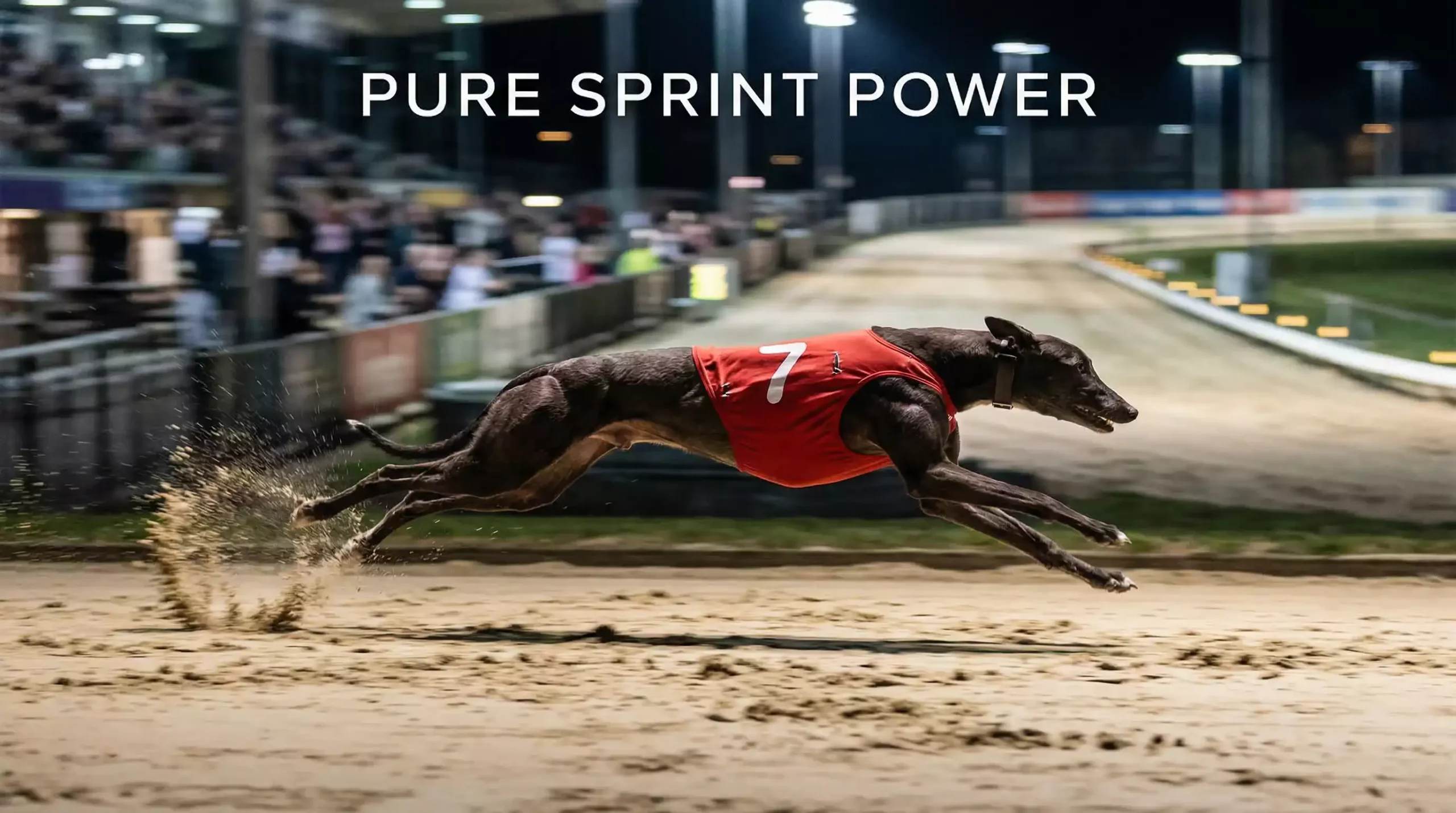
The Nottingham 305m sprint is the shortest and most explosive distance on the Colwick Park programme — a two-bend dash that typically lasts under 18 seconds and rewards one thing above all else: the ability to break fast and hold speed through two turns. There are no second chances on the 305m. A dog that loses half a length at the traps is fighting geometry for the rest of the race, because the first bend arrives at just 85 metres from the start and there simply isn’t enough track remaining to recover lost ground.
For punters, the sprint distance is both the most predictable and the most volatile trip on the card. Predictable because the variables are fewer — trap speed matters more than tactical positioning — and volatile because a single slow break can destroy the chances of the best dog in the field. Understanding the 305m at Nottingham means understanding which data points are decisive and which are noise.
Speed Profiles and What Winning Times Look Like
Winning times over the 305m at Nottingham cluster in a narrow band that shifts depending on the grade and the going. In open-class sprint competition, times below 17.50 seconds are exceptional, with the track record set by Romeo Steel at 17.32 representing the ceiling of what a greyhound can achieve over this distance at Colwick Park. In A1 to A3 sprint grades, winning times typically fall between 17.60 and 17.90. Below A3, the times stretch towards 18.20 and beyond, reflecting the speed differential between elite sprinters and mid-grade dogs.
The going allowance plays a proportionally larger role on the sprint than on longer distances, because the race is so short that even a small surface variation adds a measurable percentage to the total time. A going allowance of +10 on a 500m race represents roughly 0.3% of the total time; the same +10 on a 305m race represents closer to 0.6%. That difference matters when you’re comparing form figures across meetings run under different conditions.
Trap draw data reinforces what experience suggests: inside traps dominate the 305m. Across UK tracks, Trap 1 carries an aggregate win rate of approximately 18–19%, compared to a theoretical average of 16.6% — and on sprint distances, that advantage is amplified. The inside draw provides the shortest path to the rail, and on a two-bend race where positional jostling is compressed into a fraction of the time available over four bends, that geometric saving is often decisive.
Mark Bird, CEO of the GBGB, has spoken about the sport’s long-term future depending on public engagement and the willingness of fans to make their voices heard. Sprint races are central to that engagement strategy: they’re the format that most immediately captures attention, produces dramatic finishes, and lends itself to the kind of short-form content that performs well on social media. The 305m is greyhound racing’s highlight reel, and Nottingham’s sprint programme contributes directly to the sport’s entertainment appeal.
How Trap Draw Decides Half the 305m Races
The statement isn’t hyperbole. On the 305m at Nottingham, the dog that leads into the first bend wins significantly more often than the dog that finishes fastest. That’s because the first bend is the decisive point of the race — and the dog that reaches it first, on the rail, has a protected position that the five rivals must either match or work around.
Academic research published through PubMed Central has confirmed that Box 1 carries a statistically significant advantage in greyhound racing, while Boxes 4, 5, and 7 show a negative effect on outcomes. On sprint distances, this bias is intensified by the reduced time available for positional correction. A dog drawn in Trap 4 or 5 that misses the break by even a fraction finds itself boxed in between faster starters on either side, with the bend arriving before it can find racing room.
Trap 6 — the outside draw — occupies an interesting position on the 305m. It doesn’t have the rail advantage, but it does have clear air on the outside. A fast-breaking Trap 6 dog can sweep wide into the first bend without interference, and if it has superior speed, it can hold the outside line through both bends and win from the front. The risk is that the wide line costs ground — the outside of a bend is longer than the inside — and if the dog doesn’t have a clear speed advantage, that extra distance is fatal on such a short trip.
The middle traps — 3, 4, and 5 — are the most compromised draws on the 305m. They lack the rail protection of Trap 1, the clear outside of Trap 6, and they’re surrounded by rivals on both sides at the break. Dogs drawn in these traps need to be demonstrably faster than the rest of the field to overcome the positional disadvantage, and “demonstrably faster” means something specific: the quickest first split time in the field by a margin that compensates for the extra ground they’ll cover around the bends.
Picking Sprint Winners at Nottingham: What to Look For
The selection process for a 305m race at Nottingham can be distilled to three questions, asked in order of importance.
First: which dog has the fastest first split? Check the sectional data from each dog’s recent 305m runs. The dog that reaches the first bend quickest is the dog most likely to control the race. If two dogs have similar first splits, move to the second question.
Second: which of the fastest dogs has the better draw? A Trap 1 or Trap 2 dog with a fast split is the default selection. A Trap 5 dog with the same split speed faces a harder task. If the fastest split dog is drawn outside, weigh its speed advantage against the ground it will lose on the wide line — and check whether any rival in an inside trap has a split time close enough to contest the lead at the first bend.
Third: what do the running comments say about the dog’s trap behaviour? A fast split from three weeks ago is less useful if the dog’s most recent run shows SAw (slow away) or MsdBrk (missed break). Consistency of trap exit is more important on the sprint than on any other distance, because there’s no time to recover. A dog showing QAw in four of its last five runs is reliable. A dog alternating between QAw and SAw is a gamble — and on the 305m, that inconsistency is a disqualifying factor rather than a minor concern.
If none of the dogs in the field ticks all three boxes — fast split, good draw, consistent trap — the race is a pass. Not every 305m race at Nottingham offers a clear selection, and the discipline to skip a race where the data is inconclusive is as important as the ability to identify a strong bet when the data aligns. The sprint distance punishes imprecision more harshly than any other trip on the card, so the standard for backing a selection should be correspondingly higher.
The wider context is set out in our Nottingham dog results guide.
The draw decides these races: trap statistics.
