

Why the Same Dog Runs Faster or Slower on Different Nights
Greyhound racing going is the variable that most punters acknowledge in theory and ignore in practice. Two dogs with identical calculated times, identical form comments, and identical trap draws can produce completely different results on the same evening if the going suits one and not the other. The track surface — sand at most UK venues, including Nottingham, where an outer Swaffham McGee hare runs on a 437-metre circumference — is not a constant. It changes with rain, temperature, wind, and the passage of dogs across it during a meeting. Those changes are measured, reported, and adjustable — if you know where to look.
This article explains how going works in greyhound racing, what the going allowance means for your form analysis, and how weather conditions on a specific night can shift the balance between dogs that look evenly matched on paper.
Going Allowance: The Number That Adjusts Every Time
The going allowance is a correction factor applied to every race on a card. It’s determined before the meeting by running a trial dog — a greyhound of known ability — over the standard distance and comparing its time to an established benchmark. If the trial dog runs slower than the benchmark, the track is running slow, and the going allowance is positive (e.g., +20, meaning the surface is adding approximately 0.20 seconds to each dog’s time). If the trial dog runs faster, the going allowance is negative, indicating a quick surface.
At Nottingham, the going allowance typically ranges from around -15 on a fast, dry summer evening to +30 or beyond on a heavy, rain-soaked winter night. That swing of nearly half a second may sound trivial, but in a sport where races are decided by margins of tenths and hundredths of a second, it’s substantial. A going allowance of +25 on a 500m race at Nottingham’s 437-metre circuit means that every dog in every race is running nearly a quarter of a second slower than it would under standard conditions — enough to change the relative order of finishing positions if some dogs handle heavy going better than others.
The calculated time — the figure you should use for cross-meeting comparisons — is the actual finishing time minus the going allowance. A dog that clocks 30.10 on a night with a going allowance of +25 has a calculated time of 29.85, which is directly comparable to a 29.85 run under standard conditions on a different evening. Without this adjustment, comparing form across meetings would be unreliable because every card runs under slightly different surface conditions.
The going allowance is printed on the racecard and updated between races if conditions change during the meeting — which they can, particularly on evenings when rain starts or stops partway through the card. Punters who check the going allowance before the first race and don’t revisit it are missing potential shifts that affect the later races on the card. A meeting that starts with a going allowance of +10 might finish at +20 if persistent rain softens the sand through the evening.
Rain, Wind and Temperature: Real Effects on Sand Tracks
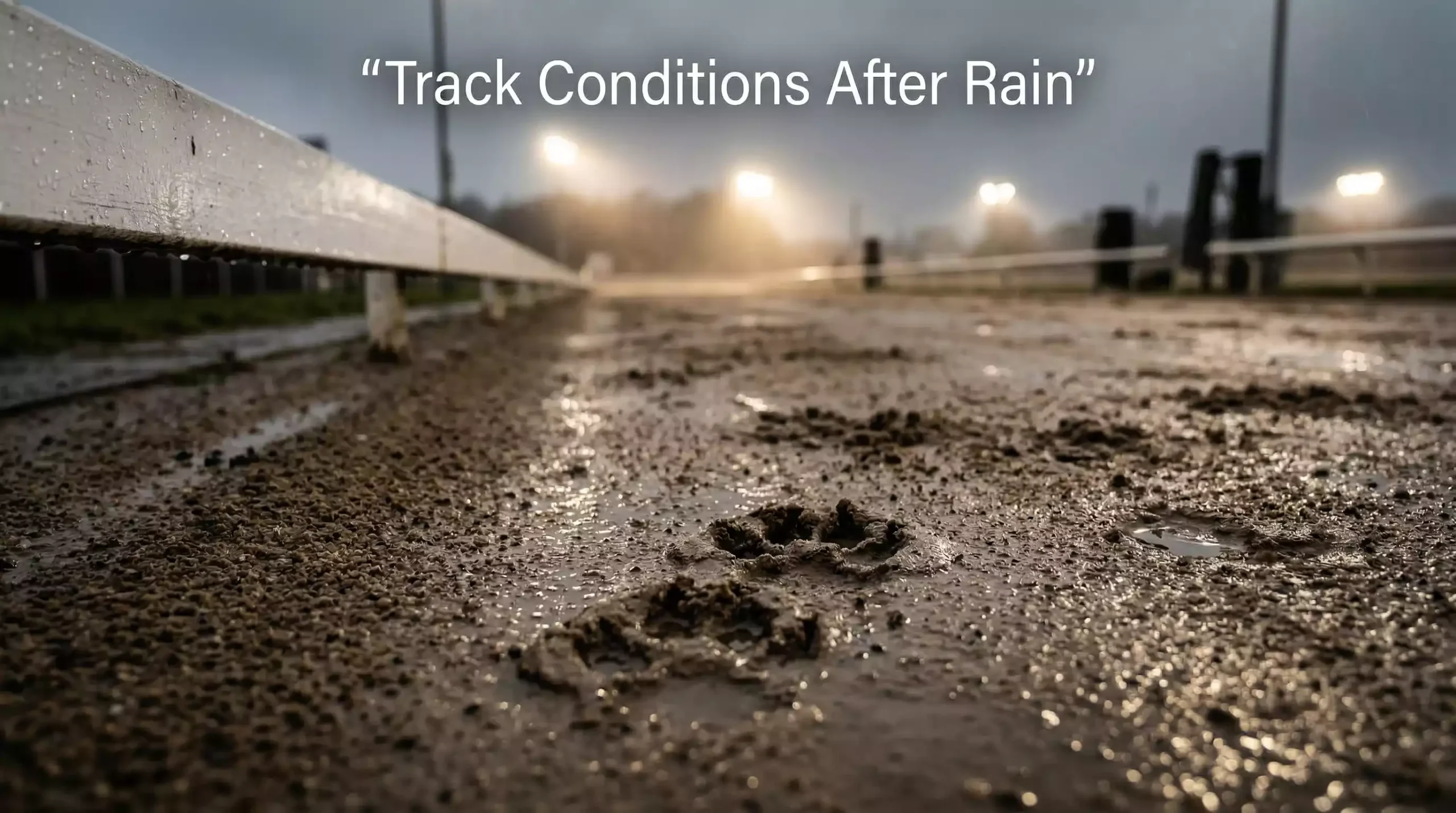
Rain is the most significant weather factor at UK greyhound tracks. Sand surfaces absorb water, and as moisture content rises, the surface becomes heavier — increasing resistance against the dogs’ paws and slowing their times. Light drizzle during a meeting has a modest effect. Sustained rainfall over several hours before and during a card can produce a going allowance that adds half a second or more to standard times. At that level, the character of the racing changes: dogs with natural stamina and physical strength gain an advantage over lighter, speed-oriented animals whose running action is less effective on a heavy surface.
Wind is subtler but no less real. Colwick Park’s location near the River Trent exposes it to crosswinds that can vary in intensity across different parts of the track. A strong headwind on the back straight slows dogs through that section, while a tailwind on the home straight can produce artificially fast finishing splits. The net effect on overall times may be small, but the positional impact can be significant: a dog that leads into a headwind section tires faster than the dogs sheltering behind it, creating opportunities for closers that wouldn’t exist on a calm night.
Temperature affects the sand surface in less obvious ways. Cold sand is firmer, which generally produces faster times because the dogs’ paws meet more resistance at foot-strike, creating a more efficient push-off. Very cold sand — near or below freezing — becomes hard and potentially hazardous, which is why meetings are abandoned in extreme cold. Warm sand is softer and more energy-absorbing, which slows times slightly. The effect is most noticeable during seasonal transitions: a Nottingham meeting in early October might produce times several spots faster than a meeting at the same track in late February, even if the going allowance looks similar, because the temperature differential changes the sand’s physical properties in ways that the allowance calculation doesn’t fully capture.
Humidity is the least discussed weather factor but it influences how sand retains moisture. High humidity slows the evaporation of surface water after rain, keeping the going heavy for longer. Low humidity on a dry, breezy evening can dry the surface out during a meeting, producing a progressive quickening of times through the card. Tracking the time trend across the first four or five races of a meeting — are times getting faster or slower as the card progresses? — gives you a real-time read on how conditions are evolving.
How to Factor Going Into Your Selections
Integrating going into your selections requires two steps: understanding tonight’s conditions, and knowing which dogs in the field handle those conditions best.
Step one is to check the going allowance before the first race and identify where it sits relative to the range you’d expect for the season. A going allowance of +15 in January is normal. The same +15 in July suggests the track has been affected by unusual rain, and dogs with form on heavy going should be prioritised. If the going allowance is negative — a fast surface — speed dogs come into their own, and the premium on early pace increases because the firm surface rewards explosive acceleration.
Step two is to look at each dog’s form under similar conditions. Most form databases allow you to filter a dog’s record by going range. A dog that has run three times on going between +20 and +30 and finished first, second, and first is clearly comfortable on heavy sand. A dog whose best times all come on fast going (-10 to +5) and whose heavy-going form shows fourth and fifth-place finishes is a conditions-dependent runner that tonight’s surface works against.
The final layer is to monitor conditions during the meeting itself. If you’re betting on Race 8 of a twelve-race card, check whether the times from Races 1 through 7 are consistent with the opening going allowance. If they’re running progressively slower, the going is deteriorating — which may change your assessment of a dog you selected before the first race based on the original allowance. Flexibility is a virtue in greyhound betting, and nowhere more so than when the going is in flux.
The wider context is set out in our Nottingham dog results guide.
