

How Greyhound Betting Fits Into the UK Gambling Landscape
Greyhound betting trends in the UK tell a story of a product that is losing ground within a market that is growing. The overall British gambling industry generated a Gross Gambling Yield of £16.8 billion in the financial year April 2024 to March 2025 — a 7.3% increase year on year, according to the Gambling Commission’s annual report. Sports betting, casino games, and online slots are all expanding. Yet within that growing pie, greyhound racing’s slice is shrinking.
This article examines the specific numbers behind that trend: how much is being wagered on dogs, where the money is going, and what structural forces are driving the decline. The data comes primarily from the Gambling Commission’s published statistics and from industry reporting on bookmaker turnover.
Betting Turnover on Dogs: Three Years of Decline
The most telling number in greyhound betting is the annual turnover figure. For the period April 2023 to March 2024, betting turnover on greyhound racing in UK bookmakers was approximately £794 million. That sounds substantial in isolation. It sounds less impressive when you compare it to the previous year — £800 million for 2022–23 — and less impressive still when you look further back: roughly £740 million for the period April 2021 to March 2022, a figure depressed by the lingering effects of pandemic-related restrictions.
The raw numbers suggest a market that has recovered from the COVID dip and stabilised around the £790–800 million range. But adjusting for inflation tells a different story. In real terms — accounting for the purchasing power erosion caused by CPI increases — greyhound betting turnover has declined by approximately 23% over a three-year window. The nominal stability masks a genuine contraction. Punters are wagering roughly the same number of pounds, but those pounds are worth less, which means the real volume of economic activity in the greyhound betting market is meaningfully lower than it was three years ago.
The causes of that decline are multiple. Greyhound racing competes for the same betting pound as football, horse racing, tennis, and an expanding array of in-play markets. The introduction of new betting products — same-game multiples in football, micro-markets in cricket — has given punters more options within sports they already follow, reducing the incentive to branch out into greyhounds. At the same time, greyhound racing’s schedule — frequent meetings, short intervals between races — which was once a competitive advantage in the betting shop, is less distinctive in an era where live football is available almost every evening.
For the sport, declining turnover has direct financial consequences. The BGRF’s voluntary levy is calculated as a percentage of greyhound betting turnover, so when turnover falls, funding falls. And when bookmakers observe a product generating declining interest, they are less inclined to maintain their voluntary contribution — creating a feedback loop that the industry has struggled to break.
Online Accounts Surge, but Greyhound Share Shrinks
The broader UK gambling market has undergone a structural transformation over the past decade, and greyhound racing has been on the wrong side of it. The number of active online betting accounts in the UK has grown from approximately 17 million in 2014 to over 37 million in 2024. That growth represents a massive expansion of the digital betting population — more people, betting more often, through more platforms than at any point in the industry’s history.
Greyhound racing has not captured a proportional share of that digital expansion. The new online customers are disproportionately drawn to football, accumulator bets, casino products, and in-play markets — categories that dominate the promotional spending of major bookmakers. Greyhound racing appears on bookmaker websites and apps, and the PGR streaming deal ensures that races from twelve stadiums are available to watch online. But appearing on the platform is not the same as being actively promoted, and greyhound racing receives a fraction of the marketing spend that football and horse racing enjoy.
The demographic dimension compounds the problem. Younger bettors — the cohort most likely to have opened new online accounts in the past five years — tend to gravitate towards sports they already watch on television: Premier League football, tennis Grand Slams, international cricket. Greyhound racing has limited terrestrial television exposure and no equivalent of the Grand National or the FA Cup Final to generate mass-market awareness. The result is a digital audience that is older, smaller, and less likely to grow organically than the audiences for competing betting products.
The PGR deal and the Greyhound Racing UK platform represent the industry’s attempt to reverse this trend. By improving the quality of streaming, making race replays freely available, and investing in content that explains the sport to newcomers, the industry is trying to build a digital audience from the ground up. Whether that effort succeeds depends on execution and sustained investment — neither of which is guaranteed when the underlying revenue base is contracting.
Betting Shop Numbers and Their Impact on Dog Racing
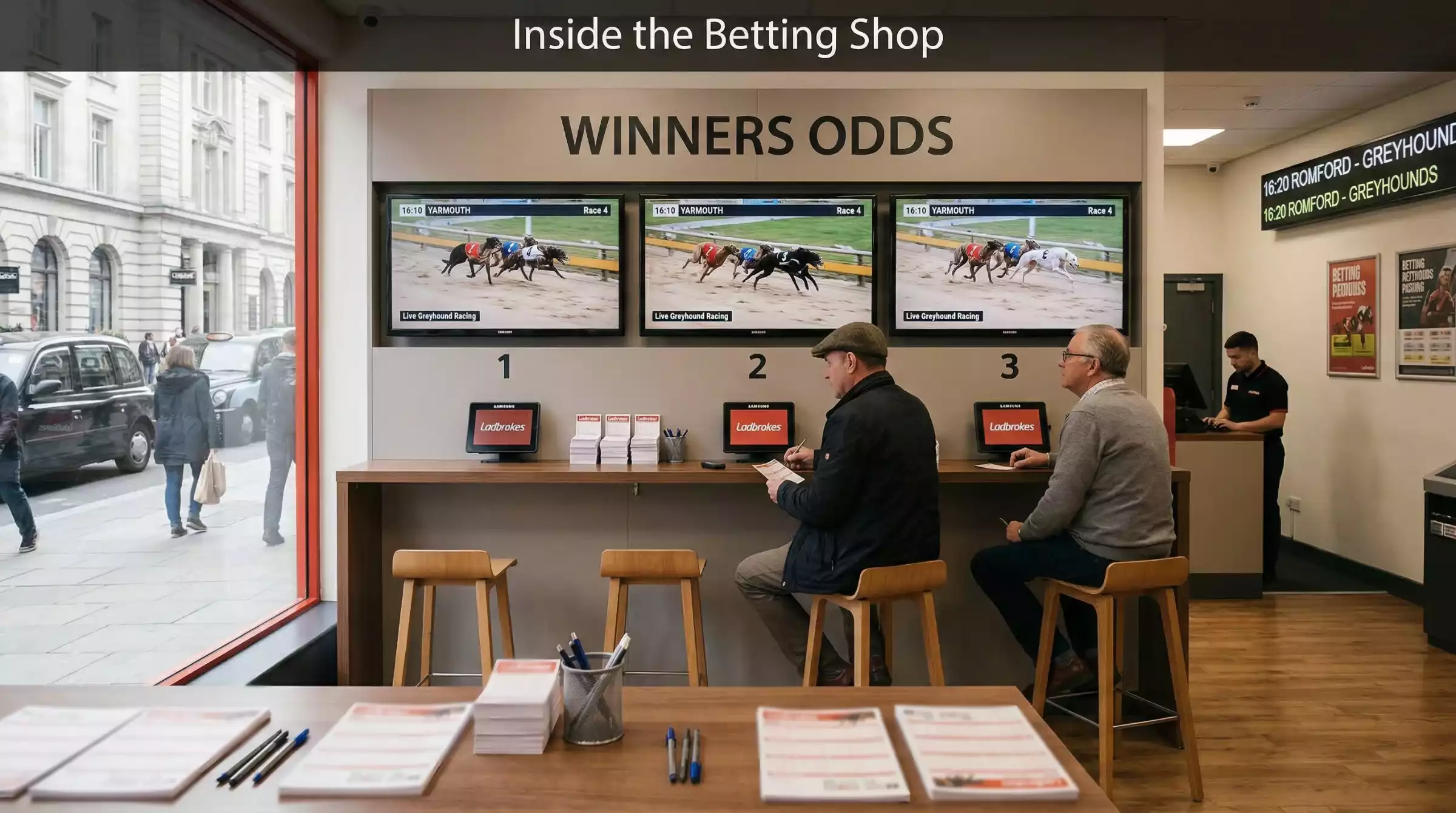
Greyhound racing’s historical heartland is the high-street betting shop, and the steady erosion of the UK’s shop network is having a measurable impact on the sport’s betting turnover. The Gambling Commission reported 5,825 licensed betting premises across Great Britain for the most recent reporting period — a decline of 1.8% year on year. That figure continues a trend that has seen the shop count fall from over 8,000 a decade ago, driven by rising business rates, the impact of the £2 maximum stake on fixed-odds betting terminals, and the migration of customers to online platforms.
The connection between betting shops and greyhound racing is deeper than it is for most other sports. In the pre-internet era, greyhound racing was the content that kept betting shops busy between horse racing cards. Meetings ran through the morning and afternoon, filling the gaps in the horse racing schedule and giving punters something to bet on during every opening hour. The SIS feed — which distributes live greyhound racing to shops — was designed specifically for this purpose, and it remains a significant part of the betting shop experience.
As shops close, they take their greyhound turnover with them. Not all of that turnover migrates online. Some shop customers — particularly older demographics who prefer the social environment and the familiarity of in-person betting — simply stop betting when their local shop shuts. And even those who do move online are entering an environment where greyhound racing competes against dozens of other products for their attention. The closure of a betting shop in a town with a local greyhound track doesn’t just reduce turnover — it weakens the cultural connection between the community and the sport.
The industry’s response has been to strengthen its digital presence and ensure that online streaming of greyhound racing is as accessible as possible. But the loss of the betting shop as a natural home for greyhound content represents a structural disadvantage that no amount of digital investment can fully offset. For a sport that was built around the rhythm of the betting shop — short races, frequent cards, immediate results — the decline of that ecosystem is a fundamental challenge.
The wider context is set out in our Nottingham dog results guide.
