

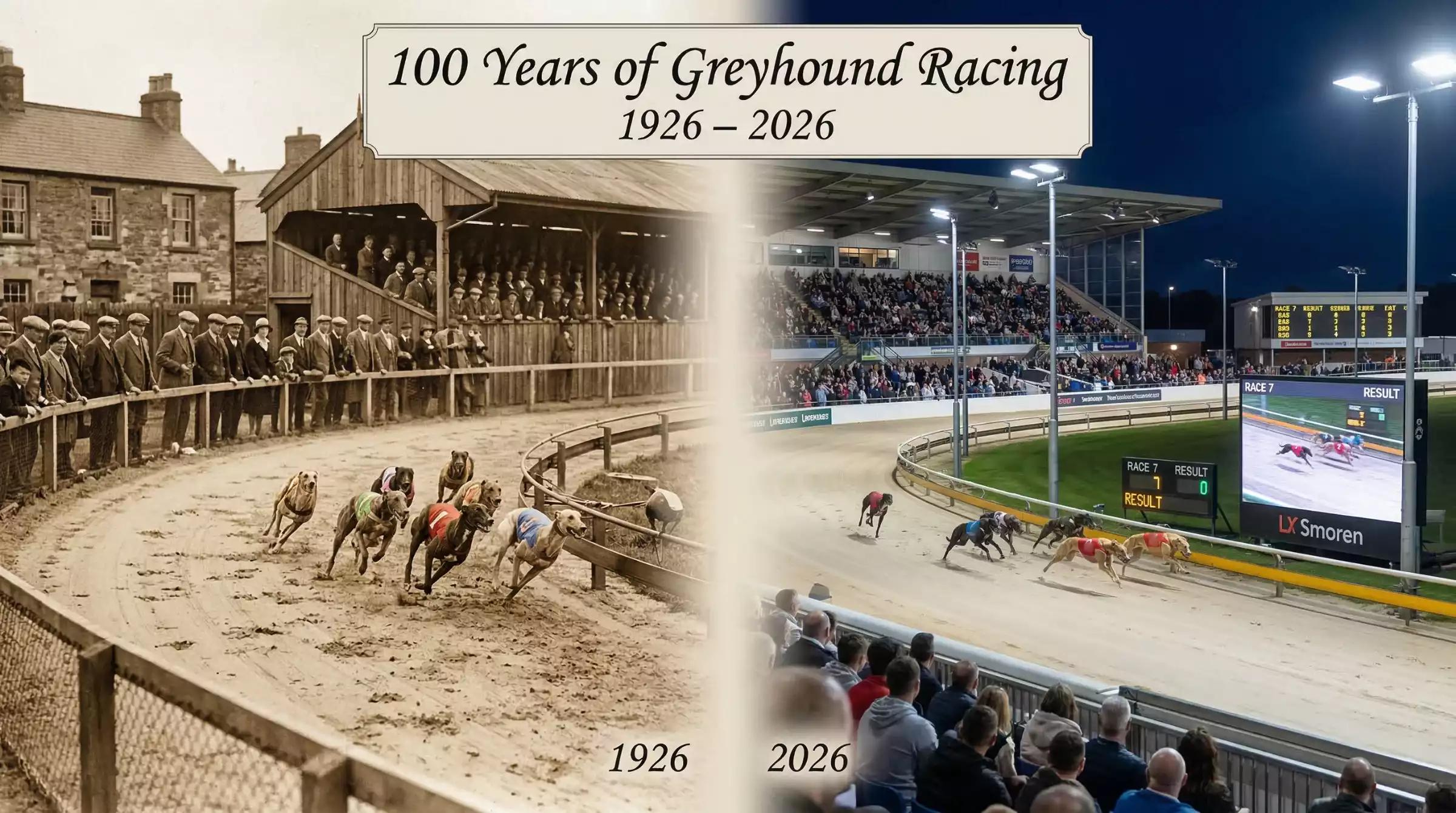
From Belle Vue 1926 to Colwick Park 2026: A Century of Dogs
The centenary of greyhound racing in the UK arrived in 2025 — one hundred years since the first organised meeting on British soil established a sport that would, at its peak, rival football for working-class attendance and become one of the defining entertainment cultures of twentieth-century Britain. The anniversary was marked with investment, celebration, and an uncomfortable awareness that the sport entering its second century is a fraction of the size it was during its first.
The story begins at Belle Vue in Manchester, where the first licensed greyhound meeting in the United Kingdom took place in 1926. Within a decade, the sport had exploded across the country. By the 1940s, it had become a phenomenon that shaped the social habits, betting patterns, and leisure time of millions. By 2026, the arc of that century encompasses golden ages, slow declines, stadium closures, regulatory battles, and a digital reinvention that is still in progress.
The Golden Age: 1940s–1960s Peak Attendance
The numbers from the golden age are almost unrecognisable compared to the modern sport. At its peak in the late 1940s and 1950s, greyhound racing attracted annual attendances exceeding 50 million across the UK. Seventy-seven licensed GBGB tracks operated alongside more than 200 independent venues — so-called flapping tracks — that ran without regulatory oversight. London alone had a dozen stadiums: White City, Wimbledon, Wembley, Harringay, Catford, and others whose names now exist only in the memories of older generations and the pages of racing history books.
The sport occupied a specific niche in the social landscape. It was evening entertainment in an era when television was still a novelty and the alternatives for a midweek night out were limited. Greyhound meetings ran after work, charged modest admission, and provided a social environment that combined spectator sport with betting — a combination that proved irresistible to a population emerging from wartime austerity. The stadiums themselves became community hubs: restaurants, bars, dance halls, and meeting places that happened to have a dog track attached.
The betting dimension was central. In the pre-betting-shop era (licensed betting shops didn’t exist until 1961), the greyhound track was one of the few legal venues where ordinary people could place a bet. The tote and on-course bookmakers provided the mechanism, and the atmosphere of a packed stadium on a Friday night — the collective anticipation, the roar as the traps opened, the post-race analysis in the bar — created a social ritual that millions participated in regularly.
Mark Bird, CEO of the GBGB, has spoken of the sport’s aspiration to maintain world-leading standards of welfare — a phrase that implicitly acknowledges that the golden age operated under standards that would be unacceptable today. Animal welfare protections were minimal, veterinary oversight was inconsistent, and the fate of retired dogs was rarely tracked. The centenary narrative requires honesty about this: the sport’s past was culturally rich but ethically incomplete.
Decline, Closures and Modern Revival Attempts
The decline began in the 1960s and accelerated through every subsequent decade. Television brought entertainment into the living room, reducing the incentive to travel to a stadium. The 1961 Betting and Gaming Act legalised off-course betting shops, which meant punters could bet on dogs without attending the track — convenient for the bettor, devastating for stadium attendance. Car ownership expanded leisure options. Competing sports, nightclubs, and eventually home computing and the internet all drew audiences away from the terraces.
The stadium count tells the story in two numbers: 77 licensed tracks in the 1940s, 18 in 2026. The collapse was not uniform — London lost almost all of its venues, while certain regions maintained one or two tracks through the contraction. But the direction was relentless, and the process accelerated in the 2010s and 2020s as land values rose and stadium owners discovered that selling to property developers was more profitable than continuing to race.
The most recent closures — Crayford, Perry Barr, and Swindon in 2025 — underscored the ongoing fragility of the stadium network. Each closure eliminated a community’s connection to the sport and reduced the operational base from which the industry generates content, turnover, and welfare funding. The opening of Dunstall Park in Wolverhampton in the same year provided a rare counterpoint, but the net trajectory remains downward.
Revival attempts have taken several forms. The Premier Greyhound Racing joint venture consolidated media rights and invested in broadcast quality. The GBGB pursued welfare reform with measurable outcomes. Individual tracks invested in hospitality and events to attract non-traditional audiences. None of these efforts has reversed the overall decline, but they have stabilised the surviving core of the sport at a level that — while modest by historical standards — is sustainable if the remaining structures hold.
Digital Reinvention: GR UK Platform and 10 Million Views
The centenary year’s most forward-looking initiative was the launch of the Greyhound Racing UK digital platform in March 2025. Designed as a centralised hub for the sport — results, replays, editorial content, and promotional material — the platform achieved over 10 million digital views in its first months of operation, a figure that suggests genuine appetite for greyhound content online even as stadium attendance continues to decline.
The platform represents a philosophical shift as much as a technological one. For a century, greyhound racing’s distribution model was physical: you went to the stadium, or you went to the betting shop, or you watched on television if the meeting was broadcast. The GR UK platform breaks that model by making the sport accessible anywhere, on any device, without requiring a bookmaker account or a stadium visit. It’s an attempt to reach the audience that will never travel to Colwick Park or Monmore Green but might watch a replay on their phone during a lunch break.
Whether digital distribution can compensate for declining physical attendance is the defining question of the sport’s second century. The economics are different: a digital viewer generates less direct revenue than a stadium visitor who pays admission, buys food and drink, and bets at the on-course tote. But a digital viewer who never would have visited a stadium generates something from nothing — and if that viewer eventually opens a bookmaker account and bets on a Nottingham card, the sport has acquired a customer it wouldn’t otherwise have had. The PGR broadcast deal provides the distribution infrastructure to reach those potential customers through every major bookmaker platform in the country.
The centenary story, then, is one of transformation rather than simple decline. The sport that drew 50 million annual spectators in the 1940s now draws a fraction of that figure through the turnstiles — but it reaches a digital audience of millions through platforms and streams that didn’t exist even a decade ago. Tracks like Nottingham, which opened in 1980 and now hosts four Category 1 events under the PGR umbrella, represent the bridge between the sport’s physical heritage and its digital future. Whether that digital reach translates into financial sustainability is the question that the next chapter of the story will answer.
The wider context is set out in our Nottingham dog results guide.
