

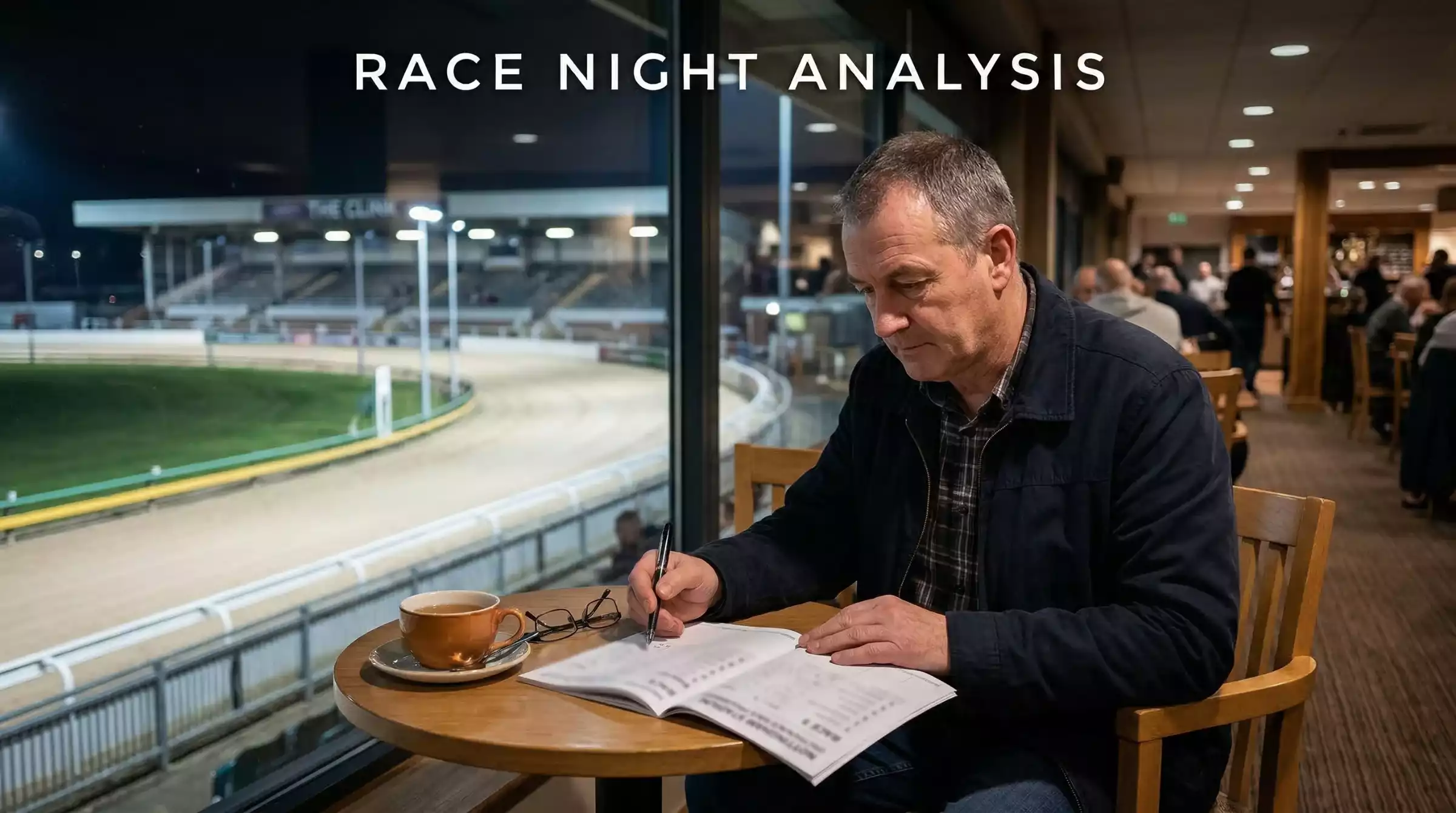
What Separates Useful Nottingham Tips from Guesswork
Nottingham dogs tips are everywhere. Social media accounts post them before every meeting. Tipping sites push automated selections with confidence ratings. Pub regulars swap picks over a pint on Friday afternoon. The volume is staggering, and most of it is noise — selections based on nothing more substantial than a dog’s name, a lucky trap number or whatever the algorithm spat out ten minutes before the first race.
Here is the uncomfortable reality that underpins the entire tipping industry: favourites in greyhound racing win approximately 30 percent of the time. That is not a failing of the market — it is a structural feature. Six dogs run in every race. The betting public collectively identifies the most likely winner, and that dog still loses seven times out of ten. If the favourite — the distilled wisdom of thousands of punters — gets it wrong more often than it gets it right, imagine how often a tip without a transparent methodology lands on the correct dog.
This guide does not offer tips for tonight’s card. It offers something more durable: the methods that produce defensible selections at Nottingham meeting after meeting. Form analysis, pace mapping, trainer data, odds assessment and session awareness — each of these tools narrows the field from six unknown quantities to a ranked shortlist based on evidence. The punters who use these methods consistently do not win every race. Nobody does. But they make fewer avoidable errors, and in greyhound racing, avoiding errors is half the battle.
Reading Recent Form for Nottingham Selections
Every selection at Nottingham begins with form — the dog’s recent racing history, compressed into a string of numbers and abbreviations on the racecard. The last six runs are the standard window, and they contain enough information to build a detailed profile of what each dog is likely to do tonight. The question is how to read that information without being misled by it.
Start with the form figures themselves. A sequence like 111234 shows a dog that won three consecutive races and then gradually declined. The decline could mean the dog was promoted above its level, encountered tougher competition, or is simply past peak form. A sequence like 432111 tells the opposite story — a dog that found its rhythm and is currently in the best form of its career. Direction matters more than the individual numbers. A dog with 333332 might look mediocre, but the trend from consistent third-place finishes to a second suggests improvement, and the next step could be a win.
Time figures add the quantitative layer. At Nottingham, which operates across eight different distances from the 305-metre sprint to the 925-metre marathon, comparing times requires care. A dog’s best time over 500 metres means little if tonight’s race is over 305. The relevant comparison is best time over the distance being raced, and ideally at Nottingham specifically. Times recorded at other tracks carry a conversion problem: every oval has a different circumference, surface, hare system and bend geometry, all of which affect the clock. A 29.40 at Nottingham is not the same as a 29.40 at Monmore or Romford.
Calculated times — adjusted for going conditions — are more reliable than raw times for cross-meeting comparisons. If the going allowance was +15 on Monday and +5 on Friday, a dog that ran 29.50 on Monday (calculated 29.35) was objectively faster than one that ran 29.45 on Friday (calculated 29.40), even though the raw Friday time was quicker. Punters who compare raw times without going adjustment are making a basic analytical error that costs money over time.
The comment line is where the numbers gain context. A dog that finished fourth with a time of 29.80 might look slow on paper, but if the comments read QAw, EP, Crd2, Bmp3 — quick away, showed early pace, crowded at the second bend, bumped at the third — the picture changes entirely. The dog ran well but encountered traffic. Strip away the interference and its underlying performance may have been closer to 29.40. Conversely, a dog that finished second with 29.30 but showed SAw, RnUp — slow away, ran up late — was not controlling the race. It relied on others to set the pace and fade, which may or may not happen again.
The grade context frames everything. Nottingham’s grading system runs from A1 at the top through to A11 at the lower end, with Open Race events sitting above the ladder entirely. A dog winning A6 races comfortably is not the same quality as a dog placing in A2 races, even if their times are similar. The A2 dog ran against sharper rivals, under more pressure, in faster-paced races. When a dog drops in grade — from A3 to A5, say — its recent times and form figures take on new meaning. What looked like moderate form at A3 could translate into dominant form at A5.
For Nottingham specifically, track familiarity is an additional form factor worth weighting. Dogs that have raced at Colwick Park multiple times develop a feel for the tight 437-metre circumference and the short 85-metre run to the first bend on the 500-metre trip. A dog making its Nottingham debut from a larger track may need two or three runs to adjust, regardless of how strong its form looks elsewhere. Check the racecard for how many Nottingham runs appear in the form string — it is a detail that separates local knowledge from generic analysis.
Pace Mapping: Predicting How a Nottingham Race Unfolds
Form analysis tells you what each dog has done. Pace mapping tells you what the six dogs are likely to do to each other. It is the difference between studying individuals and studying the interaction — and at a track like Nottingham, where the first bend arrives fast and the circumference punishes bad positioning, pace dynamics decide more races than raw speed alone.
A pace map starts by classifying each dog in the race according to its running style. The racecard comments provide the evidence. Dogs that consistently show QAw and EP are frontrunners — they want to lead from the traps. Dogs with Led and ALed notations are confirmed leaders that race best when they control the pace from the front. Dogs with RnUp, RnIn and strong finishing sectionals are closers — they sit behind the pace and pick off tiring rivals in the final straight. And dogs whose comments vary wildly from race to race — sometimes EP, sometimes SAw, sometimes Crd — are unpredictable, which makes them dangerous in forecast markets but unreliable as win selections.
Once you have classified the six runners, plot them against their trap draws. This is where pace mapping becomes powerful. If Trap 1 and Trap 2 both contain confirmed frontrunners, expect a contested first bend. Both dogs will break fast and converge on the rail line, which creates crowding and potential interference at the 85-metre mark. A peer-reviewed study published through PubMed Central confirmed that dogs running the inside rail cover the shortest actual distance, which means the fight for the rail is rational — but when two dogs contest it simultaneously, both suffer. That crowding opens lanes for dogs drawn wider, particularly a Trap 5 or Trap 6 runner with early pace that can sweep around the first-bend chaos into a clear lead.
The opposite scenario is equally instructive. If the race contains only one frontrunner — drawn in Trap 1, say — and the remaining five dogs are all closers or mid-pack runners, the frontrunner has an uncontested lead into the first bend and can dictate the pace for the entire race. An uncontested frontrunner at Nottingham, on any distance, is one of the strongest race configurations a punter can identify. The odds will often reflect this, with the frontrunner installed as a short-priced favourite, but even at shorter prices an uncontested leader at this track has a strike rate that makes it a viable selection.
Pace maps also reveal races to avoid. When four or five of the six runners are confirmed closers, the race lacks a natural pace-setter. The field will break slowly, bunch together through the early bends and produce a scrappy, unpredictable finish where small positional advantages and minor interference determine the result. These races are the domain of luck, not analysis, and the shrewd punter either sits them out entirely or plays them through forecast and tricast bets where the disorder can be turned into larger-priced combinations.
At Nottingham, the 305-metre sprint distance makes pace mapping almost binary. The first bend is the race. If one dog is clearly the fastest breaker, back it. If two dogs are equally fast breakers, check their trap draws and back whichever has the rail advantage. Over 500 metres, the pace map has more complexity — the race unfolds over four bends, so early pace must be balanced against mid-race stamina and finishing speed. And over staying distances, the pace map shifts again: early pace matters less, and the dogs with the strongest final-bend finishes become the primary contenders.
Trainer and Kennel Form at Nottingham
The trainer’s name on the racecard is one of the most underrated pieces of information available to the punter. In UK greyhound racing, the licensed trainer is responsible for the dog’s conditioning, nutrition, exercise regime, race-night preparation and tactical decisions about which distance and grade to target. There are approximately 500 licensed trainers operating across the country, with around 3,000 kennel staff supporting them. Not all trainers are created equal, and their performance at specific tracks varies significantly.
Trainer strike rate — the percentage of runners that win — is the headline metric, but it needs context. A trainer with a 25 percent strike rate across all tracks but a 12 percent rate at Nottingham is underperforming at this venue, possibly because their dogs do not suit the tight circumference or because they are stepping runners up in grade when they travel. Conversely, a trainer with a modest 15 percent overall rate but a 22 percent rate at Nottingham is a local specialist whose selections at this track deserve extra weight.
Nottingham, situated in the East Midlands, draws from a pool of regionally based trainers who run their dogs at Colwick Park regularly. These trainers know the track intimately — the way the sand plays in different weather, which traps suit which running styles, how the going allowance fluctuates across seasons. Their dogs have run at Nottingham dozens or even hundreds of times, and that familiarity breeds consistency. When a locally based trainer enters a dog at a specific distance and grade, the decision carries more diagnostic weight than when a visiting trainer from the South East or North West sends a dog on a one-off trip.
David Evans, General Manager of Nottingham Stadium, reflected on the venue’s competitive calendar by noting that the track had seen “four new Category One champions crowned” in recent fixtures, with a continued commitment to popular racing slots. That Category 1 success depends heavily on the quality of dogs that leading trainers send to Nottingham for showcase events — the Select Stakes, the Eclipse, the Puppy Classic and the BGBF Breeders’ Stakes. Tracking which trainers enter runners for these prestige events, and how those runners perform, gives you a secondary data set: trainer ambition. A trainer who consistently enters dogs for Category 1 events at Nottingham is investing in this track, and their graded entries — the Tuesday-to-Friday bread-and-butter runners — often reflect that investment in preparation and conditioning.
Kennel form extends the analysis beyond individual trainers to their broader operation. A kennel producing multiple winners at Nottingham across different dogs suggests a systemic advantage — superior conditioning, better track knowledge, or a breeding programme that produces dogs suited to this specific oval. Kennel prefixes on the racecard (the recurring first word in a dog’s name that identifies the kennel of origin) make this tracking straightforward. When you see a familiar kennel prefix next to a Nottingham debutant, the kennel’s existing record at this track becomes a useful proxy for the new dog’s prospects.
Finding Value in Nottingham Greyhound Odds
A good selection at a bad price is a bad bet. This principle is obvious in theory and almost universally ignored in practice, particularly by punters who approach greyhound racing as entertainment rather than analysis. Finding value — the gap between a dog’s true probability of winning and the probability implied by the bookmaker’s odds — is the single skill that separates profitable punters from those who subsidise the industry.
The greyhound betting market in the UK turns over substantial money. According to Gambling Commission data reported by SBC News, betting turnover on greyhound racing reached £794 million in the 2023-24 financial year. That volume means the market is liquid enough to produce reasonably efficient prices most of the time — but not all of the time. Inefficiencies exist, and they tend to cluster around specific patterns.
Best Odds Guaranteed is the first value lever. Most major bookmakers offer BOG on greyhound racing, meaning that if you take an early price and the starting price drifts longer, you receive the higher payout. This asymmetry is entirely in the punter’s favour. If your analysis identifies a dog as a 3/1 chance and the early morning price is 7/2, taking that price with BOG active costs you nothing extra if the dog drifts to 5/1 by the off — you collect at 5/1. And if the dog shortens to 2/1, you still collect at the 7/2 you took. BOG effectively gives you a free option on price movement, and punters who fail to exploit it are leaving money on the table.
Early prices versus starting prices create a second value window. Tissue prices — the initial odds set by bookmaker traders before the market opens — are based on a combination of form analysis, historical data and commercial considerations. They are not always accurate. When a tissue price significantly overrates a dog’s chances (pricing it shorter than its form warrants) or underrates them (pricing it longer), the early market is mispriced. The shrewd punter compares their own assessment of each runner to the tissue price and acts when the gap is widest. By the time the starting price is declared, the market has usually corrected — which means the value existed only in the early window.
Each-way betting adds a strategic dimension in six-runner greyhound races. Standard each-way terms on dogs are typically one quarter of the win odds for the first two places. In a competitive A2 race where the form suggests three or four dogs could win, an each-way bet on a dog priced at 5/1 gives you 5/1 for the win and 5/4 for a place. If your pace map analysis suggests this dog will finish in the first two positions more often than the place odds imply, the each-way bet represents value even if the dog is unlikely to win outright. This approach is particularly effective at Nottingham on competitive evening cards, where the gap between the top four dogs in a race is often less than a length.
Overlay and underlay are the technical terms for these mismatches. An overlay is a dog whose odds are longer than its true winning probability warrants — you are getting more value than you should. An underlay is the opposite: a dog whose odds are too short relative to its actual chance. The process of identifying overlays consistently is the core skill of profitable greyhound punting, and it requires honest assessment. If your analysis says a dog has a 25 percent chance of winning, the fair odds are 3/1. Anything longer than 3/1 is an overlay. Anything shorter is an underlay. The discipline to reject underlays — even when the dog looks certain to win — is what separates the recreational punter from the serious one.
Monday/Friday Evenings vs Wednesday/Thursday Mornings
Not all Nottingham meetings are created equal, and the session you bet on shapes the type of analysis required. The weekly racing calendar at Colwick Park splits into two distinct categories: evening meetings on Monday and Friday, with first races typically at 17:56, and morning meetings on Wednesday and Thursday, with first races around 10:54. The difference between these sessions is not just the time on the clock — it is the quality of the racing, the profile of the punters in the market and the predictability of the results.
Evening meetings on Monday and Friday are Nottingham’s flagship sessions. These cards feature stronger graded races, attract better-quality dogs and generate more betting turnover. The runners are typically in their prime racing condition, the trainers have had all week to prepare, and the atmosphere — whether you are at the track or watching on a stream — carries more energy. For the analytical punter, evening cards are where form reading, pace mapping and trap data analysis produce the most reliable results. The fields are more competitive, which means the margins are tighter, but the form data is also more consistent because the dogs are running against genuine opposition.
Morning meetings on Wednesday and Thursday serve a different function. These are BAGS (Bookmakers’ Afternoon Greyhound Service) meetings — fixtures produced primarily for the betting shop market, screened in bookmaker shops and through online streams during the daytime when horse racing is not running. BAGS cards tend to feature lower-graded races, younger dogs gaining experience and older dogs dropping down the ranks. The quality is lower on average, but — and this is the critical insight for punters — the predictability is often higher.
Lower-graded BAGS races at Nottingham frequently contain wider ability gaps between the best and worst dog in the field. In an A8 or A9 morning race, you might find one dog that would be competitive two grades higher running against five that are at or near their ceiling. That class differential makes the form reading simpler and the selections more straightforward. The trap bias data applies with equal force, but the form analysis component requires less nuance because the standout dogs announce themselves more clearly.
The odds market reflects this dynamic, however. Morning BAGS favourites are often very short-priced because the class advantage is obvious to every bookmaker and punter. Finding value on morning cards requires a different approach: rather than backing the obvious favourite at cramped odds, look for the second-best dog at an overlay price. If the form says there is a clear leader and one genuine danger, the danger is often available at 3/1 or 4/1 because the market is concentrated on the favourite. When the favourite drifts or has a poor break, that overlay dog collects at a price that compensates for the occasions when the favourite wins comfortably.
One further distinction between sessions: the going. Morning meetings run in daylight, when the sand surface is often drier and faster than under the evening lights. If you track going allowances across different sessions, patterns emerge. Wednesday mornings after a dry spell might produce consistently fast going, which favours early-pace dogs. Friday evenings after a week of rain might produce heavier going, which favours stamina-oriented runners. Adjusting your selections by session type is a layer of specificity that most tipping services never consider.
Staking Plans and Bankroll Discipline for Nottingham Regulars
Selection method is half the equation. Staking discipline is the other half, and it is the half that most punters neglect until their bankroll forces the conversation. A punter who makes excellent selections but stakes erratically — doubling up after a loss, chasing a bad night with a big bet on the last race — will lose money over time. A punter who makes average selections but stakes consistently will at least stay in the game long enough for variance to even out.
Level staking is the simplest approach: bet the same amount on every selection, regardless of confidence level or odds. If your staking unit is £10, every bet is £10 — whether the dog is 6/4 or 8/1, whether it is your nap of the night or a speculative each-way play. Level staking removes emotion from the staking decision and forces discipline. Its weakness is that it treats all bets as equal, which they are not. A selection with a 5 percent edge at 2/1 deserves a larger stake than a selection with a 2 percent edge at 6/1, but level staking does not distinguish between them.
Percentage staking addresses that weakness. Instead of a fixed amount, you stake a fixed percentage of your current bankroll — typically 1 to 3 percent per bet. This approach naturally scales your stakes: when the bankroll grows, your bets grow with it; when the bankroll shrinks, your bets decrease, preserving capital during losing runs. Percentage staking also accommodates confidence-weighted adjustments — you might stake 2 percent on a standard selection and 3 percent on a top-rated selection — but the adjustments should be modest and predefined. A punter who starts at 2 percent and drifts to 10 percent on a “certainty” is not following a staking plan. They are gambling on instinct.
Regardless of which system you choose, the bankroll itself requires definition. Decide how much money you are prepared to allocate to Nottingham greyhound betting across a defined period — a month, a quarter, a year. That amount should be money you can afford to lose entirely without affecting your financial obligations or daily life. Once the bankroll is set, protect it. If the bankroll drops by 50 percent, stop. Reassess your selection method, review your records and decide whether to reload or walk away. The decision to stop is the most important staking decision you will ever make, and making it in advance — before the losing run starts — is the only way to ensure you actually follow through.
If you or someone you know is experiencing difficulty controlling gambling behaviour, the Gambling Commission provides links to support services including GamStop for self-exclusion and GamCare for confidential advice. Responsible gambling is not a footnote. It is the foundation on which every staking plan, every selection method and every evening at the dogs should be built.
The full picture is in our Nottingham dog results guide.
